Turn the Story into a Physical Design Question
A fantasy throne becomes more useful as a concept when its story leads to visible physical choices. A woodland guardian might suggest sheltering branches, a coastal setting might inspire tidal curves, and a mechanical realm might lead to layered metal-like planes. Choose the few features that communicate the idea most clearly, then ask how a real person fits within them.
The goal is a piece of seating or a scenic prop, so the imagined world must eventually meet dimensions, materials, contact areas, handling, and installation. A realistic rendering is a starting point for that discussion. It does not establish how the object is supported or whether it is intended to be occupied.
Throne Foundations
- Define the office or role before drawing the chair.
- Decide whether the throne belongs to a person, dynasty, or institution.
- Develop several clear silhouette studies.
- Include the intended occupant early in the design.
- Connect materials to the realm's resources and skills.
- Choose a small family of related motifs.
- Give selected repairs or alterations a narrative reason.
- Plan the encounter between occupant and visitor.
- Use color to support the world rather than a fixed formula.
- Summarize the concept in a short coherent brief.
Royal Facts
- An original fantasy design can establish its own symbolic meanings.
- A strong outline remains readable when fine detail disappears.
- An inherited seat and a newly commissioned one imply different histories.
- A detachable emblem can express a changing officeholder.
- A material's scarcity matters only when the world establishes that scarcity.
- A room layout can change the perceived relationship between ruler and audience.
- A repaired component can communicate continuity within an invented history.
- A seated figure helps reveal proportion problems in a concept drawing.
- A rendered chair is a visual proposal, not a verified physical structure.
- Consistent motifs can connect the throne to architecture and costume.
Royal Picks
- Use a sketchbook for quick alternative outlines.
- Prepare a short worldbuilding sheet about authority and local craft.
- Build a reference board with clearly credited sources.
- Try a small clay or digital maquette to study the form.
- Include a representative seated figure in each serious concept.
- Create a limited material palette for the imagined culture.
- Keep a timeline of major alterations to the fictional throne.
- Test the design in a wide room view and a close portrait.
- Use lighting studies to assess which story details remain visible.
- Prepare a separate fabrication brief if the concept will become physical.
Behind the Throne
- A ruler's attempt to look approachable can be a deliberate design choice.
- The absence of personal ownership can shape an institutional throne.
- A convincing repair should relate to the material and the story.
- A small repeated motif can unify the design without overwhelming it.
- The route toward the seat can reveal how the imagined court functions.
- A costume collar can change the useful space around a backrest.
- A magical material becomes more interesting when its limits are defined.
- A worn seat and pristine emblem can imply different histories within one object.
- An original design need not resemble a famous fictional throne to feel legible.
- Removing an unrelated ornament can strengthen the world's visual identity.
Throne Wonders
- Imagine a harbor throne whose repaired bronze records a great storm.
- Design a traveling court's ceremonial seat that packs into several meaningful components.
- Create a woodland throne shaped by refined local joinery rather than tangled roots.
- Explore a council throne with replaceable emblems for elected occupants.
- Give a mountain court a seat that frames a distant summit.
- Invent a ruler who deliberately uses a modest chair beneath grand architecture.
- Make a changing textile the only visible mark of a new dynasty.
- Design an aquatic throne around the movement of its nonhuman occupant.
- Use an unfinished surface to express an office that is never considered complete.
- Let the empty throne reveal a realm's priorities through its surroundings.
Throne FAQs
- Where should fantasy throne design begin? With the world, the office, and the kind of encounter the seat supports.
- Does a fantasy throne need spikes? No. A distinctive silhouette can grow from many visual ideas.
- How many symbols should I include? Use enough to create a coherent vocabulary, not an inventory of every idea.
- Can the chair be symmetrical and still tell a complex story? Yes. History can appear in material, repair, and setting.
- Should I copy historical motifs? Research references carefully and distinguish real cultural meanings from your inventions.
- How do I make a throne feel old? Give selected wear and alterations a specific fictional history.
- Can a throne belong to a council? Yes. Shared or rotating authority can shape the seating arrangement.
- What if the occupant is not human? Design around that being's body and the story's intended use.
- Can the concept become a real prop? It can be developed into a separate practical specification by an appropriate maker.
- How do I know when to stop adding detail? Return to the brief and remove details that do not support its central idea.
Choose the Seat's Role Before Adding Lore
Define whether the piece is a ceremonial focal point, a film prop, a photo-op seat, or a display sculpture. Each role changes the important viewpoints and interactions. A camera-facing prop can be developed around a controlled composition, while a destination seat may be seen from every direction.
Keep the fictional premise concise enough to guide design decisions. Describe the mood, the occupant, and the central visual idea. Additional worldbuilding is useful only when it changes the physical form, surface, or experience you are trying to create.
Build a Silhouette That Survives at a Distance
The outline is the part of a throne people are likely to remember first. Develop several small shapes before drawing surface detail. One concept might rise like a narrow sail; another might spread into a broad wave; a third might frame the occupant with two restrained vertical forms. Compare them as dark shapes, then include a seated figure to see whether the person remains part of the composition.
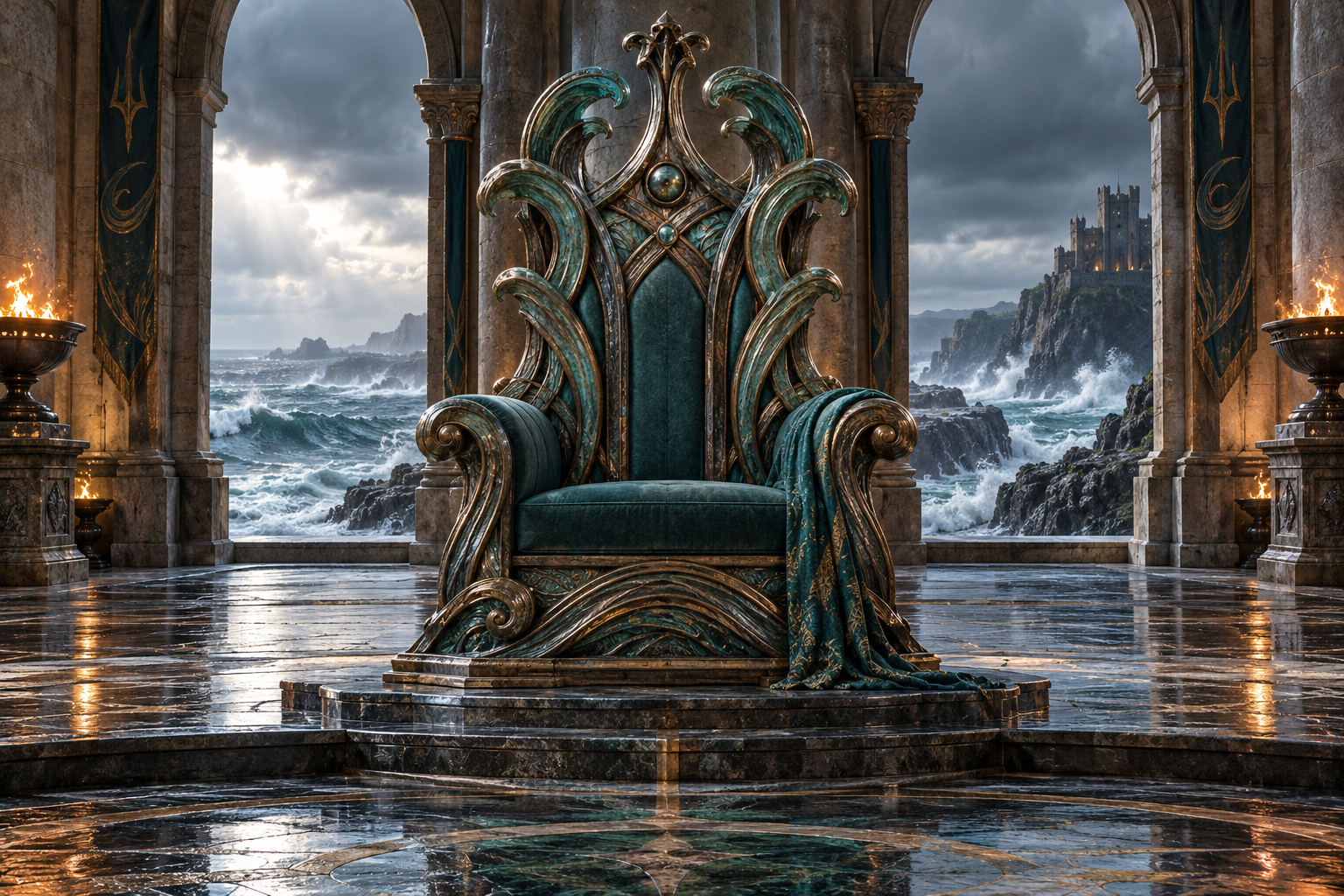
For the harbor throne, paired wave forms could create a balanced back without turning into literal sea creatures. Their outer curves might rise around an open central space, leaving room for the occupant's head and shoulders. The design begins to suggest its landscape while retaining the clarity of a seat. Small silhouette studies make it easier to reject a complicated idea before investing time in intricate carving, texture, and decorative attachments.
Translate Imagined Materials into Real Surfaces
A design may appear to be grown from roots, carved from ice, or formed from ancient metal without using those literal substances. Separate the visual effect from the structural and decorative systems that might produce it. Review samples of texture, sheen, color, and edge treatment at the intended viewing distance.
The surface illusion needs to work with the whole object. A convincing aged-metal finish can lose its effect where it meets an untreated seam, and oversized texture can overwhelm the occupant. Material studies help resolve those transitions before the complete form is fabricated.
Create a Small, Consistent Symbolic Vocabulary
An original throne becomes easier to understand when its motifs belong to the same story. Choose a few related forms and develop them across different scales. A flowing curve can shape the back, a smaller echo can appear in an arm, and a quiet border can repeat it in the textile. The motifs do not have to illustrate the realm's entire history in one chair.
For the harbor kingdom, consider a knot, a tidal line, and an open horizon as the principal ideas. A knot can suggest collective responsibility within this fictional culture; the horizon can keep the seat visually connected to its outlook. These meanings are invented for this world, not claims about universal historical symbols. Keeping that distinction clear gives you freedom to create a coherent visual language without flattening real cultural imagery into a generic fantasy decoration kit.
Use Surface History with Restraint
Wear, repairs, and layered finishes can suggest that a fictional seat has a past. Place those cues where the physical story makes sense: touched arms, exposed edges, replaced panels, or sheltered recesses. The purpose is to reinforce the concept, not cover every surface in random distressing.
For a real installation, simulated age must remain distinguishable from actual damage that affects use. Agree which marks are intentional and document the finish so future care does not erase the design or overlook a genuine problem.
Design the Space and the Encounter Together
The throne's position shapes how people meet its occupant. A long approach can create distance. A small council circle can suggest negotiation. A seat beside an open doorway can connect authority to public life. Choose the encounter you want the scene to create before adding a vast staircase simply because it looks impressive.
Our harbor court might place the throne at floor level within a sheltered sea-facing hall. Petitioners can approach along a broad central route, while council benches remain close enough to feel involved. The ocean view becomes part of the composition, reminding the occupant and audience of the office's purpose. This arrangement creates a particular kind of authority: ceremonially distinct but connected to the daily work of the port. Another story could deliberately invert that relationship.
Consider How the Occupant Actually Uses the Seat
A fantasy throne still benefits from a believable relationship with a body. Consider posture, clothing, armor, wings, tails, or any other features relevant to the imagined occupant. The goal is not to force every fictional species into a human armchair. It is to make the relationship intentional enough that the viewer can understand how the seat is used.
The harbor ruler may wear a heavy formal coat with a broad collar. That suggests reviewing the space between the back and head rather than filling it with ornament. If the design later becomes a physical prop or chair, a maker must develop the concept for its actual intended use. A beautiful rendering does not establish that a structure can be occupied. Keeping the concept and fabrication brief distinct allows imaginative freedom without confusing appearance with a completed furniture specification.
Use Color and Light to Reveal the Story
A fantasy throne does not need a single brand palette or a predictable glowing accent. Choose color according to the world and the desired scene. Sea-green cloth can connect the harbor chair to its setting, while a warm metal surface prevents the whole composition from becoming uniformly cold. A brighter replaced cushion could even signal a new administration's attempt to change the court's mood.
Light should reveal the features that matter. A side-lit repair becomes noticeable; a soft central light preserves the occupant's expression; a bright horizon can connect the throne to the sea without turning the person into an unreadable silhouette. Test the scene in more than one lighting condition. A design that only works in a single dramatic close-up may need adjustment if it must remain convincing across an illustrated sequence, game environment, or filmed conversation.
Create a Brief That Can Survive Development
Bring the concept together in a brief with the intended use, occupant relationships, silhouette, key motifs, material effects, site conditions, and transport needs. Identify which features define the idea and where the maker has room to propose alternatives.
Use models and samples to answer uncertainties in stages. A clear fantasy premise can remain intact even when connections, scale, or fabrication methods change. The strongest physical design preserves the story's essential visual cues while becoming more coherent and practical through development.
Related Articles
Dragon Throne Ideas: From Dramatic Wings to Carved Scales
Dragon wings, scales, claws, and curling tails offer far more than decoration. Discover how to turn those forms into a clear, balanced throne concept with a readable silhouette…
Color and Upholstery for Statement Seating
Color and upholstery can transform the character of statement seating. Explore palettes, texture, pattern scale, seams, trim, and real lighting to create a coherent seat for interiors, events,…
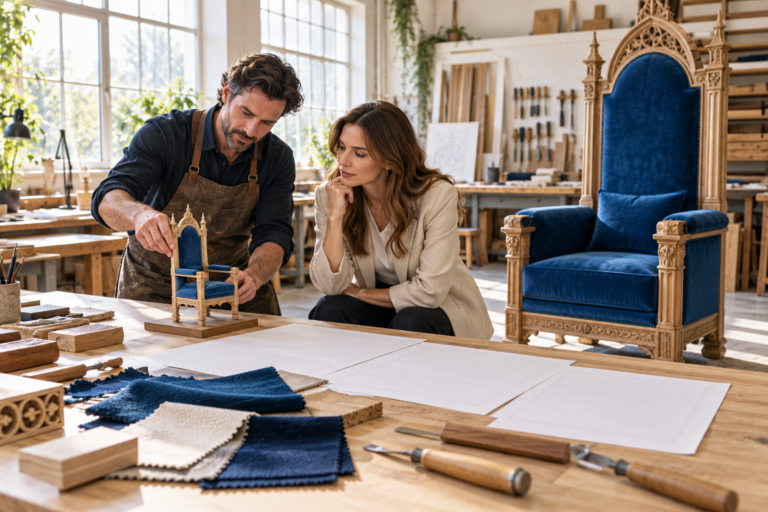
Commissioning Custom Seating: Turn an Idea into a Clear Design Brief
A striking idea becomes a successful commission through clear decisions. Learn how to turn inspiration into a practical throne design brief, collaborate with a maker, review samples and…