
A Character Can Enter Through the Furniture
The camera enters a hall and finds a throne waiting. Before the ruler appears, the audience can begin forming an impression: austere or extravagant, carefully maintained or neglected, rooted in ceremony or assembled for a new regime. A well-designed throne prop contributes to that first reading. It is part of the scene's storytelling rather than simply an impressive chair placed behind an actor.
Its development brings together several viewpoints. The script suggests the throne's role, the designer shapes its identity, the camera determines what is visible, and the performer gives it life. Materials, transport, maintenance, and continuity make that vision repeatable during production. This guide follows the process from the first story questions to the finished scene, focusing on the choices that make an original throne prop convincing on screen.
Throne Foundations
- Begin with the scene's action and emotional purpose.
- Define the throne's relationship with its character.
- Review silhouette through the intended camera positions.
- Include the actor's approximate seated outline in concepts.
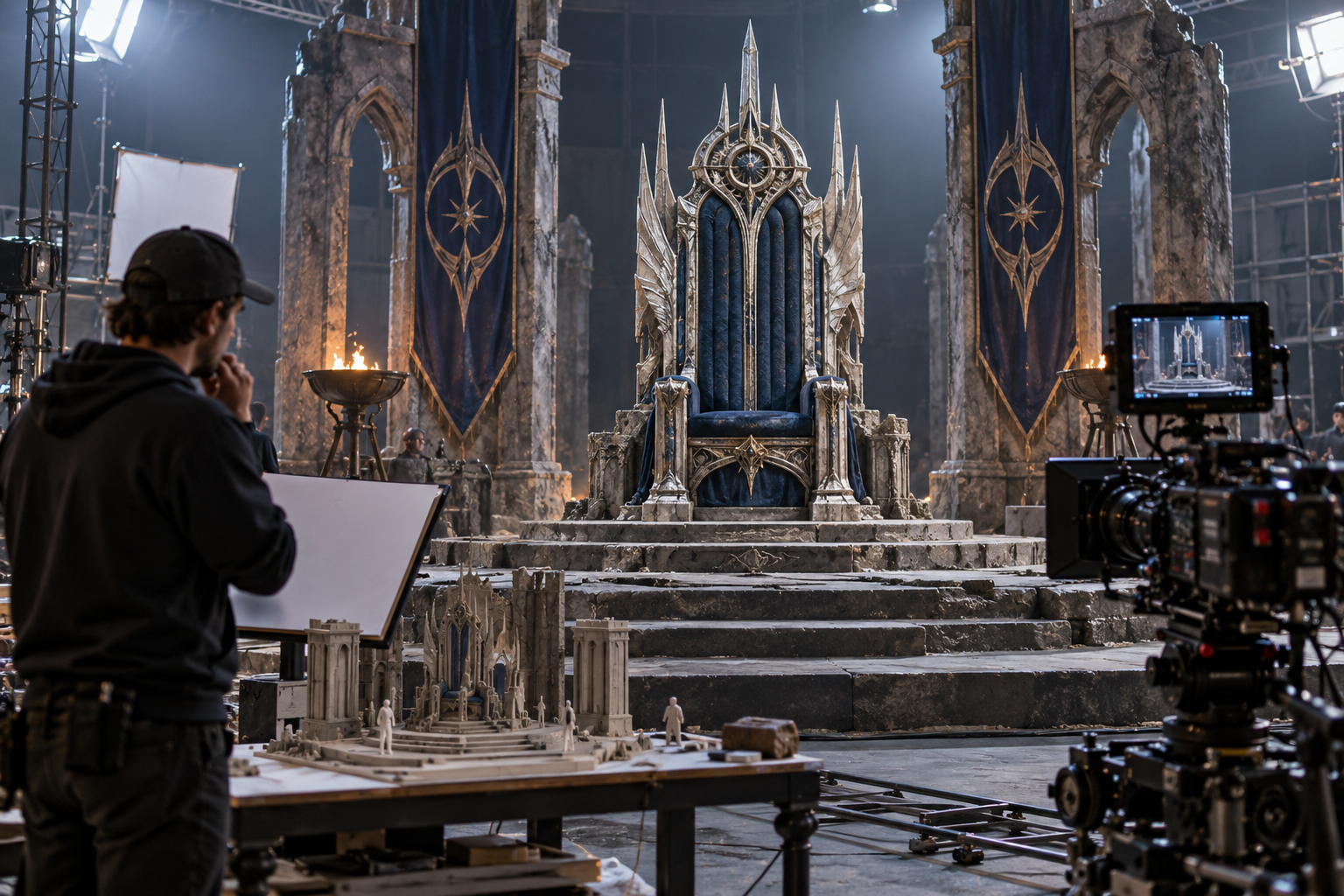
- Use a model to connect furniture and architecture.
- Discuss physical performance requirements before finalizing ornament.
- Choose material systems around viewing and handling needs.
- Develop a purposeful fictional surface history.
- Test costume, light, actor, and throne together.
- Record the approved setup for repeatable continuity.
Royal Facts
- A front drawing does not reveal every side-angle overlap.
- A prop's visible material can differ from its supporting construction.
- Close-up surfaces may need different detail from distant ornament.
- Costume can change how an actor fits within a throne.
- Side lighting can exaggerate relief and surface texture.
- A bright reflection can shift attention within a shot.
- A detachable component can become a continuity detail.
- Production wear and intentional story damage are different things.
- Set models help teams discuss spatial relationships.
- A successful prop must support the intended action as well as the image.
Royal Picks
- Prepare a short scene brief before collecting visual references.
- Draw several silhouettes with a seated figure.
- Review front, side, and key camera angles.
- Use a maquette or digital model for set discussions.
- Make representative surface samples for camera tests.
- Include costume in a full setup review.
- Keep approved finish references with the production record.
- Photograph important cushion and ornament positions.
- Identify removable components and their approved configurations.
- Plan access for the team responsible for maintenance and reset.
Behind the Throne
- A character can appear deliberately at odds with an inherited seat.
- The prop need not carry every detail of the world's history.
- A quieter central back can give an actor's expression more room.
- A narrative repair should be placed where the camera can actually see it.
- A model can expose a spatial problem before full-size fabrication.
- The most detailed surface is not always the most visible one.
- A finish change can solve a visual problem without redesigning the frame.
- A removable crest requires repeatable alignment if it appears in several scenes.
- Continuity records protect the meaning of deliberate surface wear.
- The throne's strongest contribution may happen before its occupant speaks.
Throne Wonders
- Create a new ruler's polished emblem on an inherited weathered throne.
- Use a replaced textile to suggest a change in court identity.
- Design an imposing seat that makes one character appear intentionally small.
- Frame a quiet performance with a restrained architectural back.
- Let a missing ornament become part of a scene's visual mystery.
- Develop a throne whose appearance changes between public and private settings.
- Use a subtle material contrast to separate costume from upholstery.
- Build a scale model showing the full approach to the seat.
- Give a ceremonial prop a deliberately modest human contact area.
- Make the empty throne establish the atmosphere of a room.
Throne FAQs
- Should the throne be designed before reading the scene? Read the action first so the object serves the story.
- Does a throne prop have to use real metal or stone? No. A suitable scenic system can create the intended appearance.
- Why include the actor in design reviews? Body position, costume, and movement affect the result.
- What does a scale model add? It makes the relationship between throne, architecture, and other figures easier to discuss.
- How much surface detail is enough? Match detail to the planned camera distance and narrative purpose.
- Can lighting rescue a confusing design? Tests can help, but a clear underlying form gives the team a stronger starting point.
- What should continuity photographs show? The visible setup, cushion positions, ornament alignment, and intentional wear.
- Can a throne be both furniture and a prop? It can, with its intended physical use explicitly developed.
- Should a historical replica include invented damage? Distinguish research-based reconstruction from creative production choices.
- What is the final measure of success? The throne supports the scene, the performance, and a believable visual world.
Read the Scene Before Drawing the Seat
Begin with what happens around the throne. Does the character hold a formal audience, sit alone after a defeat, refuse the seat, or offer it to someone else? Is the prop a background presence or the center of a crucial exchange? Those actions establish priorities that a purely decorative reference board cannot provide.
Identify the relationship between character and object. A ruler who inherited an oversized seat may look deliberately uncomfortable within it. Another may have commissioned a chair that presents a carefully constructed public image. These are creative interpretations to develop with the production team, not universal meanings attached to particular styles. The design should support the scene's intended reading while leaving the actor room to perform. A throne that tells too many unrelated stories can distract from the one the camera needs to show.
Develop the Silhouette with the Camera in Mind
A prop must be readable within a shot. The back can frame the actor, establish a strong background shape, or create visual tension around the figure. Its height and width should be reviewed with the intended camera positions, including wide views, medium compositions, and closer angles. A silhouette that looks magnificent in a front elevation may create a confusing overlap from the side.
Include a representative seated figure in concept drawings and compare more than one outline. Think about where the actor's head, shoulders, and hands will appear. Avoid designing every edge to demand attention. The throne's role may be to establish the world quickly and then allow the performance to lead. Clear large forms can do that work more effectively than a dense field of fine decoration that becomes indistinct in the final framing.
Use Models to Explore the Whole Set
A scale model can help connect the throne to architecture, approach routes, and surrounding furniture. It gives the team a way to discuss the complete scene rather than treating the chair as a separate object. The V&A's theatre and performance resources document design work through materials including set models, drawings, photographs, and performance records, illustrating how these different forms of evidence contribute to understanding a production. V&A Theatre & Performance
For a new project, use the model to test relationships: the distance from doorway to seat, the height of surrounding walls, and the way secondary figures gather. A model is a discussion tool, not a substitute for practical production planning. Its value is making a spatial idea visible early enough for the team to revise it before full-size construction turns an uncertain decision into a much larger commitment.
Specify the Performance Requirements Early
The script may require more than ordinary sitting. A performer might stand abruptly, turn toward another character, manage a long costume, or repeatedly enter and leave the seat between takes. Discuss the intended action with the relevant production team before the decorative concept becomes fixed. A throne that looks perfect empty can interfere with the exact movement the scene depends on.
Clarify whether the prop is occupied furniture, a background object, or part of a specially planned action sequence. Those uses need appropriate practical development and review. Keep that process connected to the design rather than assuming the shop will somehow solve it after the shape is approved. Costume and props should be considered together, especially where armor, headwear, capes, or elaborate sleeves affect the available space and the performer's relationship with the arms and back.
Choose Materials for the Shot and the Workday
A throne's screen appearance and its physical construction can be different stories. Scenic work can suggest aged metal, carved stone, elaborate timber, or an imagined substance through a combination of substrates, ornament, and finish. The right approach depends on how the object will be seen, used, moved, and maintained across production.
Ask which surfaces appear in close-up and which remain background. A detailed arm beside an actor's hand may need a different visual treatment from a distant upper crest. Consider handling and repair as part of the brief. A removable ornament can simplify transport or replacement, but its join should be treated deliberately so it does not become an accidental focal point on camera. The best material strategy supports the intended image while making the prop workable throughout the actual production schedule.
Create a Surface History That Serves the Story
Surface treatment can suggest a throne's fictional history. Repaired gilding, rubbed arm details, a replaced cushion, or a removed emblem can imply changing use. Choose these details according to the story and the way the object would be encountered in that imagined world. Random distressing may create activity without creating meaning.
Develop the finish in samples and test it with the intended lighting. A texture that looks subtle in the workshop can become exaggerated under side light, while a carefully painted detail can disappear in a dark shot. Keep the most important narrative traces readable without requiring a close-up the scene never provides. If the throne represents a real historical object, distinguish documented features from production invention and use appropriate research rather than presenting speculative decoration as a faithful reconstruction.
Test the Actor, Costume, Prop, and Light Together
A camera test is valuable because the separate design choices finally become one image. The actor's outline, costume texture, upholstery, metallic details, and background can either support one another or compete. A dark coat against a dark back may lose definition. A bright crest might draw the eye away from an expression. A strong reflection can make a decorative feature more prominent than intended.
Test the important shot types rather than relying on a single attractive angle. Include the movement or posture that matters to the scene. The aim is not to eliminate all visual drama; it is to direct it. When an adjustment is needed, it may be as simple as changing a textile value, quieting a finish, shifting a light, or modifying a small projection. Testing allows those changes to be purposeful rather than last-minute guesses.
Make Continuity and Maintenance Part of the Design
A convincing throne must remain consistent across takes and scenes unless the story calls for a change. Cushion placement, removable crests, visible wear, and accessory positions can all become continuity details. Record the approved setup with clear reference images and identify any components that move between configurations.
Plan how the prop is reset, checked, and repaired during production. Keep finish references and approved replacement materials accessible to the team responsible for them. Distinguish intentional fictional damage from accidental wear acquired during handling. A small repair can affect the image if it changes a prominent highlight or texture. These practical records preserve the design's story, allowing the same throne to feel like the same object even when filming happens out of narrative order.
Let the Prop Support the Performance
The finished throne succeeds when its design choices become part of the scene's logic. Its silhouette helps establish the character, its materials belong to the world, its physical form supports the intended performance, and its details remain readable through the camera. The audience does not need to notice every decision for those decisions to contribute.
From sketch to screen, the process is a sequence of useful conversations between story, image, body, and object. Keep those conversations connected. A spectacular throne that fights the scene is less effective than a more focused design that makes the moment clear. The most memorable seat is the one that feels inseparable from the character and world the production is bringing into view.
Related Articles
Color and Upholstery for Statement Seating
Color and upholstery can transform the character of statement seating. Explore palettes, texture, pattern scale, seams, trim, and real lighting to create a coherent seat for interiors, events,…
Commissioning Custom Seating: Turn an Idea into a Clear Design Brief
A striking idea becomes a successful commission through clear decisions. Learn how to turn inspiration into a practical throne design brief, collaborate with a maker, review samples and…
Designing Statement Seating: Form, Comfort, and Fit
A memorable seat needs more than a striking silhouette. Explore how form, usable dimensions, comfort, materials, and setting work together to turn an imaginative chair into a convincing…