
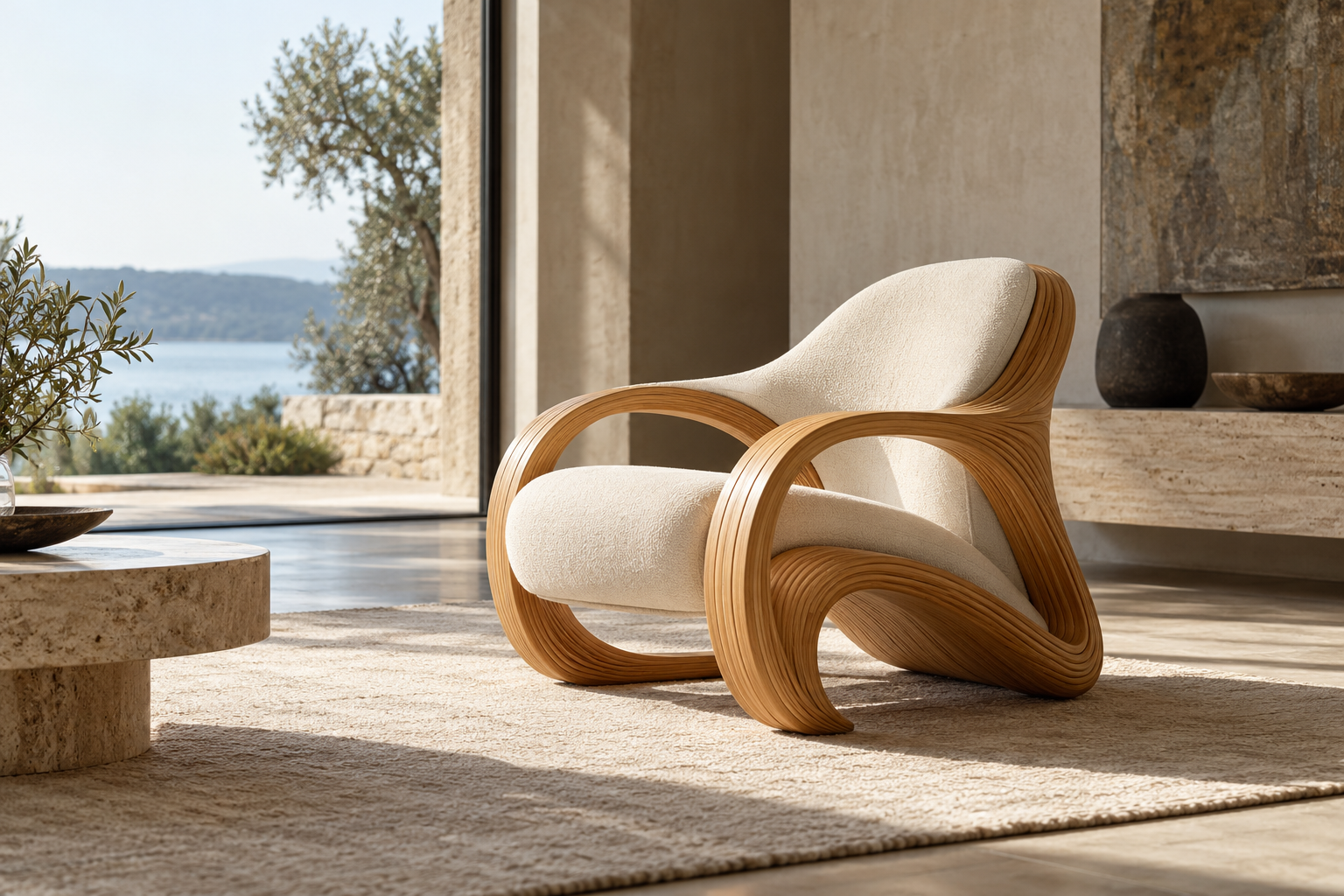
Some chairs shape the character of an entire room. A sweeping back, unexpected material, bold curve, or unusual relationship between solid and empty space can make seating feel like sculpture. Statement chairs invite a closer look without needing a crown, a crest, or a royal setting. This section explores how physical form creates that impact and how the idea changes when a person sits down. The view from the entrance may be dramatic, but the side profile, rear surface, and relationship to neighboring objects matter too. We look at visual weight, symmetry, repetition, contrast, texture, and the balance between expressive shape and a usable seat. A sculptural chair might stand alone in a quiet interior or become the focal point of a lively public environment. Its design should respond to that context. Explore carved forms, folded planes, enveloping shells, exaggerated silhouettes, and restrained geometric compositions. The aim is to understand what makes a chair distinctive, then connect that visual ambition with human scale, material behavior, and the experience of the surrounding space.
Throne Foundations
Identify the chair's main visual gesture: a sweeping curve, a folded plane, a dramatic void, or a striking relationship between two materials. Develop that idea through the whole object rather than adding unrelated features to every surface.
The occupied geometry can remain simpler than the expressive outer shell. Consider where the chair will be seen from, because a statement piece placed in an open interior must work from the side and rear as well as from its presentation angle.
Royal Facts
Negative space contributes to the form. An opening beneath an arm, a gap behind a back, or the relationship between supports can make a substantial object appear lighter. Conversely, a low solid base can give a narrow seat visual weight.
These impressions are not measurements of actual strength or mass. Distinguish visual balance from physical performance, and review both. A rendering can communicate an elegant gesture while concealing the real thicknesses and connections needed to produce it.
Royal Picks
Choose references that illustrate the particular design question: continuous curves, exposed joints, soft upholstery within a hard shell, or the treatment of an open back. Compare small models from several viewpoints at the same height as a seated and standing observer.
Make representative samples of difficult transitions rather than only flat finish boards. A full-size seat outline can test the occupant's place within an expressive frame. The goal is to connect sculptural intent with a convincing human-scale experience.
Behind the Throne
Study the junctions where the concept becomes furniture. How does the back meet the seat? Where does upholstery stop?
What happens around the underside and at the point where a person places a hand? An impressive front view can conceal an unresolved transition in any of these areas. Develop the fabrication sequence alongside the form so concealed fasteners and replaceable parts remain accessible. The finished chair should express a clear idea through these details, not only through its overall silhouette.
Throne Wonders
Try reducing a concept to one dominant feature and a supporting background. Remove decorative elements one at a time and see when the chair loses its identity.
This helps distinguish a strong gesture from accumulated detail. Another exercise is to rotate a model slowly and note where the form changes character: a broad front may become a narrow side profile, or a solid-looking back may reveal an opening. Those transitions can become the most memorable part of the design.
Throne FAQs
Must a statement chair be large? No; contrast with the setting can make a compact piece visually prominent.
Does sculptural seating have to be uncomfortable? Expressive outer form and occupant-facing geometry can be developed separately.
Should every surface be equally dramatic? A quieter area can help the main gesture read clearly.
How can a design be assessed beyond a rendering? Review multiple views, a human-scale study, material transitions, and the proposed construction rather than approving only the most flattering image.