
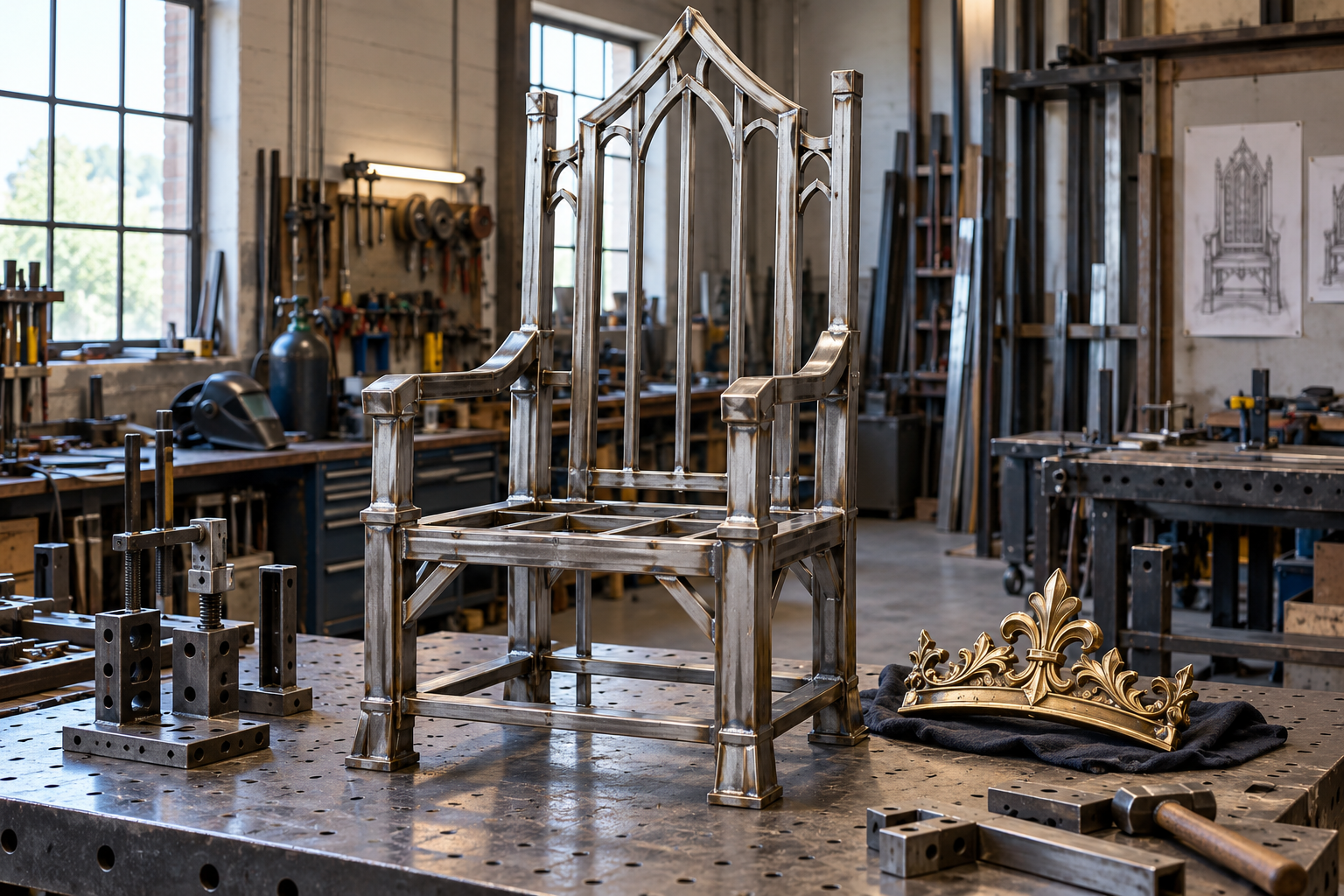
An ornate throne can conceal a spare metal framework. Understanding that frame means looking beyond its finish to the material sections, connections, geometry, and intended use. Metal Frames & Supports explores the decisions that turn a sculptural outline into a fabrication brief. Compare welded, bolted, and hybrid assemblies through access, transport, repair, and the needs of the complete design. A removable crest is a different proposition from a removable back that helps support the occupant. Consider where upholstery brackets, cladding, and service panels belong before the frame is covered, and why fabrication sequence matters when heat can change alignment. This section encourages clear drawings and a qualified conversation with the people developing the structure, rather than selecting tube sizes from a photograph. Surface treatment also belongs in the plan: preparation, inaccessible corners, repeated assembly points, and future touch-ups can affect long-term presentation. Whether the metal remains visible or disappears beneath fantasy ornament, a well-documented framework gives the project a practical foundation, preserving the information needed to assemble, inspect, maintain, and discuss the finished throne with confidence.
Throne Foundations
- Define the metal frame's job before choosing decorative profiles: occupant support, scenic support, removable ornament, or transport assembly.
- Specify the actual alloy, section, and wall thickness rather than describing every metal component simply as steel or aluminum.
- Prepare drawings that show connections, brackets, base contact, and access for assembly and inspection.
- Choose welded, bolted, or hybrid connections according to the intended design and service requirements.
- Discuss frame geometry and intended loads with a qualified fabricator before translating a tall throne concept into occupied furniture.
- Plan fixtures and reference points that hold parts in alignment during fabrication.
- Coordinate upholstery, panels, and decorative attachments before their mounting locations become inaccessible.
- Account for finishing access around corners, enclosed areas, and assembled ornament.
- Separate removable transport joints from permanent connections in the fabrication drawings.
- Record the finished frame's orientation, assembly hardware, inspection points, and intended use for the owner.
Royal Facts
- Tube size alone does not establish a frame's capacity; material, wall thickness, geometry, joints, and use all matter.
- Welding introduces heat, and the resulting contraction can move components out of their intended alignment.
- Miller's welding guidance identifies distortion as movement associated with weld-metal contraction during the welding process.
- A decorative ground-smooth surface does not by itself establish the quality of the hidden connection.
- Bolted assemblies require deliberately designed interfaces rather than arbitrary holes drilled after fabrication.
- A metal framework and its decorative cladding can have separate attachment and maintenance requirements.
- Different alloys and welding processes require different preparation and operating information.
- A polished finish can reveal waviness and fabrication marks that a textured coating makes less visible.
- Removable back assemblies can simplify transport while introducing additional connections that need documented assembly.
- A visually substantial base may still need review for the complete throne's stability and intended interaction.
Royal Picks
- Use a dimensioned frame drawing with joint callouts when requesting comparable fabrication quotations.
- Request material identification and connection details alongside photographs of the finished metalwork.
- Prepare a physical interface sample where a metal bracket meets timber, upholstery, or scenic cladding.
- Choose inspection access before covering the frame with permanent decorative panels.
- Use clearly labeled hardware packs for assemblies that must be dismantled between venues.
- Ask the fabricator to document the approved weld process and inspection approach appropriate to the project.
- Keep coating samples made on the actual substrate and preparation system planned for the throne.
- Use a protected storage arrangement that supports the frame without resting weight on decorative projections.
- Request an assembly drawing showing sequence and orientation for every removable structural section.
- Compare proposals on documented scope, intended use, finish preparation, and handover information rather than appearance alone.
Behind the Throne
- A hidden frame can simplify the exterior silhouette while making later inspection harder unless access is designed in.
- Decorative curves and structural members need not follow identical paths; the distinction should remain clear in the drawings.
- The welding sequence can influence alignment, so fabrication planning begins before the first permanent seam.
- Grinding for visual smoothness changes the surface and can affect a joint if material is removed without an appropriate plan.
- A detachable crest creates different demands from a detachable back that participates in supporting the occupant.
- Mounting holes for upholstery should be coordinated with frame design rather than added wherever the upholsterer finds space.
- A throne designed for frequent touring needs repairable interfaces and repeatable alignment as well as an attractive initial finish.
- Mixed-material decoration may move or age differently from its metal support, requiring intentional attachment details.
- Coating damage around repeated assembly points can reveal where handling and hardware protection need improvement.
- Fabrication photographs taken before cladding can become valuable maintenance records years after the throne is completed.
Throne Wonders
- Explore a visibly articulated metal frame whose repeated connection shapes become the throne's decorative rhythm.
- Design a removable sculptural crest that transforms one approved frame between several event identities.
- Create a cutaway exhibit pairing an ornate exterior with photographs of the framework concealed beneath it.
- Develop a throne concept whose negative spaces reveal its construction instead of hiding every supporting member.
- Compare brushed, textured, and patinated sample panels under the same portrait lighting.
- Imagine a repaired ceremonial frame where replacement brackets are intentionally distinguished from original components.
- Design an ornament system that attaches to dedicated mounting points without altering the main frame between events.
- Create a touring case layout that stores detachable metal details in their actual assembly order.
- Explore a slender-looking silhouette through an engineered internal framework and lightweight nonstructural surface forms.
- Build a fabrication storyboard showing how separate metal sections become a coherent throne after documented assembly.
Throne FAQs
- Is steel always better than aluminum for a throne? No. Suitability depends on the design, fabrication methods, use, transport needs, and complete structural assessment.
- Can I choose tube dimensions from a similar-looking chair? Appearance does not reveal material grade, wall thickness, connections, or loads; use a properly developed design.
- Why did a frame move during welding? Heating and contraction can distort an assembly; review preparation, fixturing, and welding sequence with the fabricator.
- Are bolted connections suitable for a touring throne? They can be when deliberately designed, documented, and assembled with the specified hardware and inspection procedure.
- Should every weld be ground invisible? Only where the approved design and finish approach allow it; visual smoothness is not the primary structural criterion.
- When should upholstery brackets be added? Coordinate them during frame design so mounting positions and service access are resolved before finishing.
- Can decorative cladding strengthen the frame? Treat it as nonstructural unless the complete design explicitly assigns and verifies a structural role.
- How do I request an accurate fabrication quote? Supply dimensions, intended use, material requirements, connections, finish expectations, transport constraints, and handover requirements.
- What records should accompany a metal throne? Keep drawings, material and connection information, assembly instructions, review documentation, and maintenance or inspection guidance.
- Can a metal throne be used outdoors? Specify the actual exposure and complete material-and-coating system; a metallic appearance alone says nothing about outdoor suitability.