
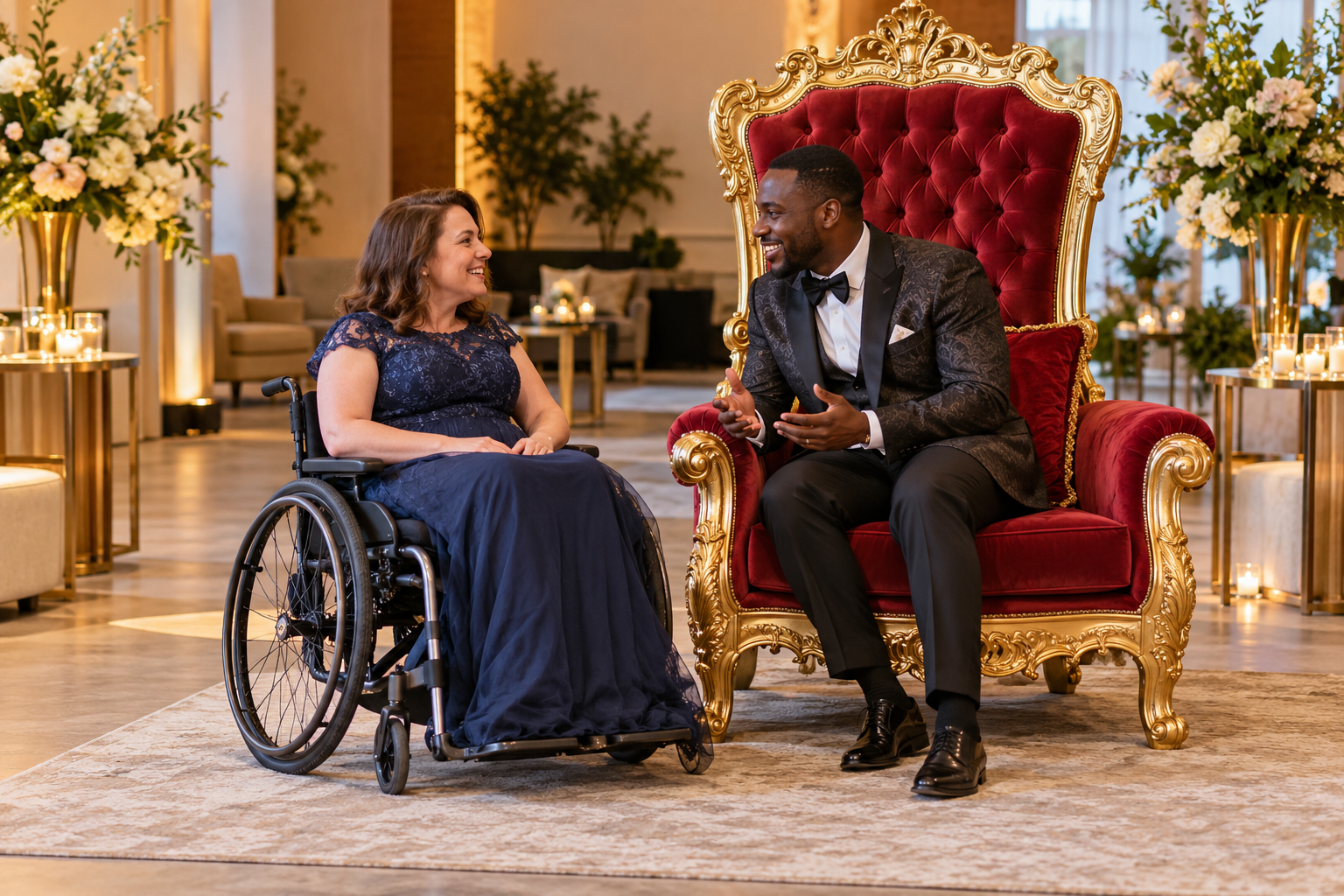
The most memorable seat in the room should still welcome the person using it. Visitor Flow & Accessible Experiences begins with the experience of approaching, sitting, participating, and leaving. Explore how seat height, depth, cushioning, arms, and nearby space work together, and why comfort cannot be judged from softness alone. Consider a visitor wearing a costume, an older guest attending a ceremony, or someone who would prefer an alternative portrait position. Different bodies and activities need different arrangements; one dramatic chair cannot automatically serve them all. This section encourages practical trials, clear conversations with users, and thoughtful alternatives designed into the occasion from the beginning. Learn to distinguish decorative cushions from useful support, recognize when a platform complicates access, and consider how staff can assist without making participation feel exceptional. The aim is a throne experience that respects dignity as well as visual impact. By testing the complete setting rather than admiring the empty chair, you can identify changes that make royal seating more comfortable, understandable, and welcoming for the people who bring it to life.
Throne Foundations
- Start with the intended occupant and sitting task; brief portraits and a long ceremony create different comfort requirements.
- Usable seat depth determines how far back a person can sit while relating to the backrest and front edge.
- Seat height should be considered alongside the person’s foot position and the surrounding floor or platform.
- Cushion softness and cushion support are different qualities to assess during a seating trial.
- Backrest contact depends on shape, angle, padding, and how the occupant actually sits.
- Armrests affect elbow placement and the available route into or out of the chair.
- Clear space around the throne matters separately from the dimensions of its seat.
- Clothing, mobility equipment, and assistance arrangements can change the room needed around an occupant.
- Accessibility planning should include the approach, positioning, use, and departure from the entire seating area.
- Ask the person using the throne what works for them rather than inferring their needs from a photograph or diagnosis.
Royal Facts
- An ornate arm can project inward and reduce the usable opening beside a seat.
- A thick seat cushion changes the occupant’s position relative to the arms and backrest.
- A loose cushion can feel different from upholstery fixed directly over the seat assembly.
- A high decorative back does not guarantee that the occupant contacts a supportive surface.
- A smooth-looking covering can feel different depending on its texture, seams, and underlying padding.
- A footstool changes the space in front of a throne and should be included in the approach plan.
- A raised dais adds a separate access issue even when the chair itself is a suitable fit.
- A removable arm is useful only when the maker has designed and documented its removal and reattachment.
- Comfort preferences can differ between people using chairs with the same dimensions.
- A room layout can restrict access to an otherwise usable chair by placing decor or furniture beside it.
Royal Picks
- Choose a seating trial with the actual occupant over a comfort claim based only on product photographs.
- Compare cushion samples on a representative support surface, rather than squeezing loose foam in isolation.
- Review upholstery swatches for touch as well as color when bare arms or shoulders may contact them.
- Use a measured layout to reserve clear space beside the throne before adding decorative objects.
- For event clothing, test representative garments with the arm opening and seat depth.
- Consider alternative seating nearby so participation in an occasion does not depend on using one particular throne.
- If arm removal is required, compare designs explicitly made for that function.
- For a lengthy ceremony, evaluate the complete sitting arrangement rather than focusing on the first few seconds.
- For an individual with specific positioning needs, involve the person and their chosen relevant professional in selection.
- Ask venue staff to review the throne’s location as part of the event’s wider accessibility arrangements.
Behind the Throne
- Begin the conversation with the occupant’s preferred way of approaching and using the seat.
- Ask before offering physical assistance; assistance should follow the person’s preferences and the agreed event arrangements.
- Keep the route to the throne available during the event, rather than checking it only before guests arrive.
- Review how a cushion behaves when the person changes position; a comfortable first impression may not describe longer use.
- Look for hard carved edges where hands, forearms, or clothing naturally meet the chair.
- Check the complete arrangement with decorative drapes, rugs, and nearby props in their intended positions.
- Discuss whether the occupant wants their mobility equipment positioned nearby within the photograph or seating area.
- For a ceremony, identify who can adjust the arrangement discreetly if the occupant becomes uncomfortable.
- Review access again when the throne moves to a different platform or venue.
- Record successful adjustments for recurring events so the occupant does not have to explain the same preference repeatedly.
Throne Wonders
- A visually grand throne can be designed around the occupant’s needs instead of asking the occupant to adapt to its ornament.
- An inviting seating area can offer several equally considered ways to take part in the same celebration.
- A carefully shaped upholstered insert can soften the experience of sitting within an elaborate carved frame.
- A lower visual barrier beside a seat can make the throne feel more approachable without losing its focal presence.
- Moving a decorative object can improve access without requiring any change to the chair itself.
- Coordinated alternative seating can belong to the event’s visual concept rather than appearing as an afterthought.
- A full-size mockup allows comfort and access to influence the design before decorative details become fixed.
- Thoughtful camera composition can celebrate a person’s preferred seating arrangement without hiding the equipment they use.
- A throne’s sense of welcome can come from the space around it as well as the chair’s upholstery.
- Listening to an occupant’s experience can reveal design improvements that exterior measurements alone would miss.
Throne FAQs
- Does a softer cushion always feel more comfortable? No. Judge the complete cushion and support assembly with the intended occupant and sitting duration.
- Can a high-backed throne still be uncomfortable? Yes. Height alone says little about where the occupant meets the backrest, the padding, or the sitting position.
- Should I add a cushion to improve fit? A cushion can change several dimensions at once. Recheck the person’s position relative to the arms, backrest, and floor.
- What should I ask someone about access needs? Ask how they prefer to approach, sit, position equipment, and receive assistance, rather than making assumptions about their abilities.
- Does accessible seating only concern the chair? No. The route, surrounding clear space, platform, nearby furnishings, and event arrangements also matter.
- Can I remove an armrest to make entry easier? Only use a removal arrangement designed and documented by the maker; do not improvise by detaching a structural component.
- How should I assess comfort for a long ceremony? Allow a representative seating trial and discuss support, clothing, foot position, and opportunities to change position with the occupant.
- What if the ceremonial throne does not suit a participant? Arrange a suitable alternative with comparable visibility and dignity within the event layout.
- Who should select seating for a specific positioning requirement? The person using it should direct the choice, with their chosen relevant professional when individual support needs require that expertise.
- Should mobility equipment be moved out of a photo? Ask the person what they want. Do not treat removal or concealment as an automatic part of the portrait.