
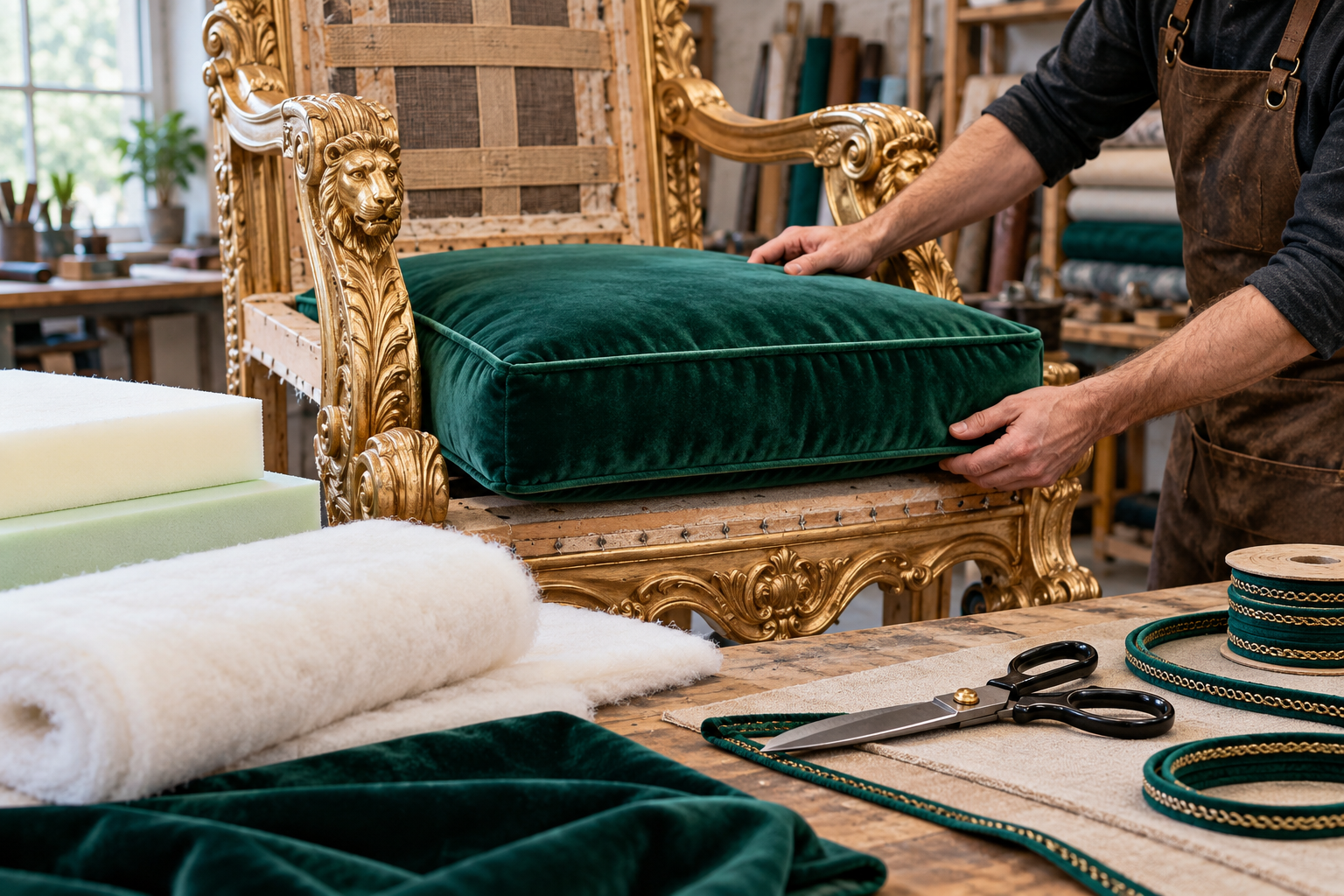
A throne's fabric is only the visible face of its upholstery. Beneath it, support, foam, wrap, seams, and attachment determine how the seat feels and how it can be maintained. Upholstery & Cushion Making follows that complete system, from an irregular seat template to a cushion fitted on the actual chair. Learn why density and firmness describe different foam qualities, how compressed height affects posture, and why the back may need a different approach from the seat. Pattern placement, fabric direction, piping, tufting, and closures all influence the result before the first seam is sewn. A swatch can become an awkward composition when stretched across a tall back or drawn into deep buttons. This section brings those visual choices together with samples, cutting layouts, and removable-cover decisions. Consider cleaning instructions, repair access, and the way cushions stay in position during use. The aim is upholstery that belongs to the throne's shape and purpose, with enough documentation to make later replacement a considered continuation of the design rather than an attempt to match a fading memory.
Throne Foundations
- Assess the frame and seat support before replacing padding; upholstery cannot correct an unresolved structural problem beneath it.
- Specify the intended sitting duration, users, and environment before selecting cushion materials.
- Measure the actual seat shape, including curves and taper, rather than assuming it is a perfect rectangle.
- Treat foam density and firmness as separate specifications when comparing cushion options.
- Plan the complete cushion system: support, foam, wrap, cover, seams, closure, and attachment.
- Choose fixed upholstery or removable cushions according to cleaning, maintenance, and the throne's intended appearance.
- Mark fabric direction and pattern placement before cutting repeated panels.
- Allow for seam construction and closure details in the pattern instead of cutting directly to finished dimensions.
- Test the compressed cushion height with the actual frame because padding changes the occupant's relationship to arms and back.
- Document fabric and foam specifications so later repairs can reproduce more than the original color.
Royal Facts
- Foam density describes mass per unit volume, while firmness describes resistance to compression; they are not interchangeable.
- Sailrite offers upholstery foam in multiple firmness levels within a density category, illustrating why both values matter.
- A cushion's thickness and supporting surface influence its feel alongside the foam's individual specifications.
- Boxing is the fabric band joining the upper and lower panels of a boxed cushion.
- Piping outlines a seam and can emphasize a cushion's shape, but it also adds construction steps and bulk.
- A patterned fabric may require additional material to align motifs across the seat, back, and arms.
- Fabric nap can change apparent color when adjacent panels face different directions.
- A removable cover does not automatically mean it is machine washable; cleaning depends on the specific material.
- Outdoor fabric alone does not make the foam, thread, support, and whole cushion assembly suitable for outdoor exposure.
- Deep decorative tufting changes the cushion's surface contour and how its pattern is distributed.
Royal Picks
- Order foam samples and evaluate them on a support resembling the throne's seat rather than squeezing them only by hand.
- Make a full-size paper or template-material pattern for irregular seat shapes.
- Use fabric swatches large enough to assess motif scale against the throne's back and arm proportions.
- Prepare a seam sample combining the actual fabric, thread, piping, and closure materials.
- Select sewing equipment appropriate to the planned layers and material rather than assuming any household machine will manage them.
- Keep the previous cover as a reference when useful, while checking it for stretching or earlier alterations.
- Use a labeled cutting layout to keep mirrored panels, nap direction, and pattern repeats organized.
- Choose a closure location that remains reachable after the cushion is attached to the throne.
- Ask suppliers for current cleaning instructions and relevant performance documentation for the exact fabric selected.
- Create an upholstery specification sheet recording foam, wrap, fabric, seams, closures, and cushion attachment details.
Behind the Throne
- A very thick cushion may improve the empty throne's proportions while leaving a seated user's feet poorly positioned.
- The seat and back need not use identical foam because their shapes and support roles differ.
- A boldly centered motif can shift visually once fabric is pulled into tufting or wrapped over curved edges.
- Decorative nail trim should be planned around the available fixing surface and the upholstery layers beneath it.
- A cushion that slides forward can change effective seat depth, making attachment part of the comfort assessment.
- Removable upholstery panels can simplify repair when the throne's decorative frame is difficult to dismantle.
- Wrinkles can come from pattern shape, padding transitions, or tension; pulling harder is not always the appropriate correction.
- A replacement cushion should be evaluated as a complete assembly rather than matched only to the old foam's uncompressed thickness.
- Contrast piping can clarify silhouette but also makes inconsistent seam lines more noticeable.
- Cleaning access matters on ornate seating: tight junctions between fabric, carving, and trim can collect debris.
Throne Wonders
- Design interchangeable cushion sets that change a throne from understated daily seating to a richly patterned ceremonial version.
- Create a fabric-placement study showing how one large motif looks centered, offset, and divided across separate panels.
- Explore a reversible loose cushion with coordinated faces and an intentionally designed edge band.
- Develop a sample board comparing smooth upholstery, shallow channels, and tufting on the same back outline.
- Use a restrained fabric field with one embroidered emblem positioned where it remains visible above the sitter.
- Create a restoration journal pairing surviving fabric fragments with the reasoning behind replacement materials.
- Imagine a seasonal upholstery collection that changes color while retaining identical fit and attachment points.
- Compare contrasting piping with self-piping to see how edge emphasis changes the apparent cushion size.
- Design removable arm pads that protect carved areas while visually belonging to the main cushion set.
- Build a material library where each finished sample includes its underlying padding, making visual and tactile comparison possible.
Throne FAQs
- Does high-density foam always feel firm? No. Density and firmness are different properties; compare both specifications and try a suitable sample.
- How thick should a throne cushion be? Evaluate the actual seat support, available height, intended users, and compressed feel rather than choosing a universal thickness.
- Can I reuse an old cover as a pattern? It can help, but check distortion, seam allowances, and previous alterations against the actual seat.
- Why do matching fabric panels look different? Nap direction, lighting, and pattern orientation can change their appearance even when they came from one fabric roll.
- Should the cushion be removable? Removable cushions can simplify cleaning and repair, while fixed upholstery supports other shapes and details; choose for the intended use.
- Can I wash a zippered cover? A zipper only makes removal possible; follow the exact fabric and construction's cleaning guidance.
- Why does new foam feel different from my sample? Thickness, cover tension, wrap, support, and the full cushion construction can change the perceived feel.
- How much extra patterned fabric should I buy? Develop a cutting layout using the actual repeat, panel dimensions, direction, and desired motif alignment.
- Can outdoor fabric protect ordinary indoor foam? Do not assume so. Specify the entire cushion assembly for its expected exposure and drying conditions.
- When should I test comfort? Test an early full-size cushion mockup before final sewing, then confirm the finished assembly on the actual throne.