
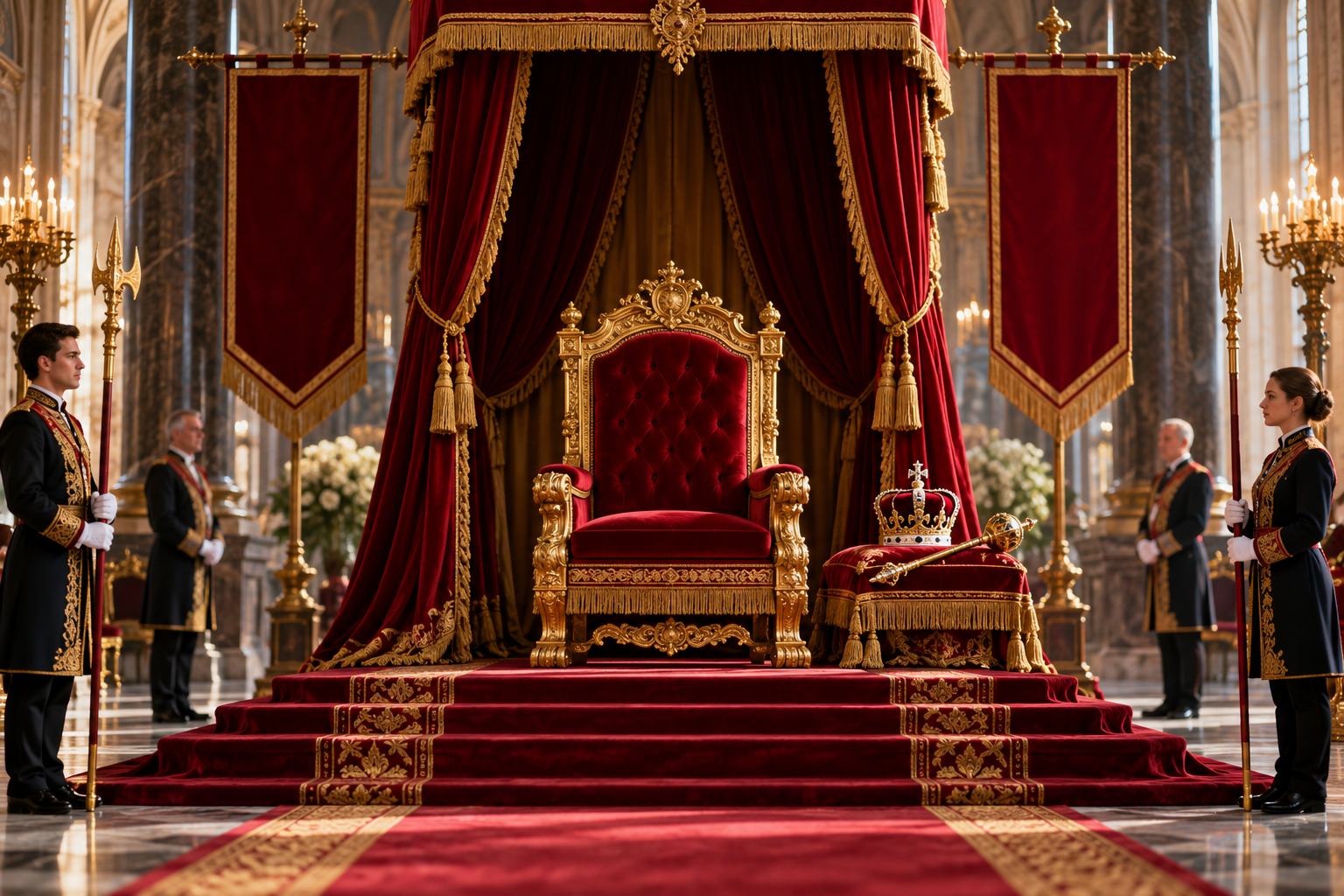
Symbols, crests, and ornament give statement seating a recognizable identity. A carved leaf can soften a heavy frame, a geometric border can sharpen its outline, and a sculpted emblem can turn an ordinary back into a focal point. This section explores how decorative details work across ceremonial thrones, contemporary chairs, oversized seating, themed environments, and photo opportunities. Begin with the shape of the seat, the people who will occupy it, and the distances from which it will be seen. Then consider the placement, scale, repetition, material, and finish of each motif. Explore crest profiles, monograms, animal forms, botanical patterns, abstract relief, upholstery accents, and original symbols developed for imagined worlds. Historical references remain valuable when their context is identified, but decoration need not imitate royal regalia to feel distinctive. Discover how ornament connects to fabrication through carving, applied panels, sculpted forms, embroidery, and surface treatments. The aim is a coherent design in which every detail supports the seating's character, remains legible in use, and belongs convincingly to the surrounding space and the experience it creates.
Throne Foundations
- Start with one dominant motif and supporting details; give the eye a clear focal point instead of treating every surface equally.
- Distinguish a symbolic emblem from a purely decorative pattern. One conveys a particular association; the other may organize rhythm or texture.
- In seating design, a crest can describe the upper finishing feature of the back; it need not carry a heraldic device.
- Place the main ornament within the chair's silhouette before refining its small details, so the overall form remains convincing at a distance.
- Check the occupied composition: a sitter's head, shoulders, clothing, or arms may conceal an emblem that dominates an empty-chair rendering.
- Develop borders, corner details, and central motifs as related elements, using consistent curves, angles, or repeated shapes to connect them.
- Separate decorative volume from the supporting assembly. A carved-looking panel can express the theme without explaining the structure beneath it.
- Choose ornament for the setting: an intimate interior invites close detail, while a distant landmark depends more on recognizable shape.
- Treat historical and culturally specific motifs as contextual references rather than assuming every crown, animal, or color has one universal meaning.
- For an original themed chair, write a short description of what its invented symbol represents before translating that idea into form.
Royal Facts
- Relief ornament projects from a background surface; its apparent depth changes with the direction of light and the shadows it creates.
- An incised line cuts into a surface, while an applied detail adds a separate element; their edges and attachment need different consideration.
- A monogram combines identifying letters, whereas a repeated geometric pattern can establish identity without representing a person's initials.
- Symmetry can organize a formal composition, but deliberate asymmetry needs its own visual balance rather than an accidental mismatch of details.
- The same motif can read differently when carved, embroidered, printed, or painted because each treatment changes its edges, texture, and shadows.
- A large central emblem may become less visible when the chair is occupied; its apparent importance in a catalog view can be misleading.
- Fine detail does not automatically improve distant recognition. Small cuts and narrow gaps may merge into one texture from the approach route.
- A metallic finish can emphasize highlights without indicating solid metal construction; describe the actual material and surface treatment separately.
- Repeated ornament creates rhythm through both the motif and the space between motifs. Uneven spacing can distract even when individual pieces match.
- The rear elevation can carry a separate decorative composition when a statement chair is visible from all sides within its setting.
Royal Picks
- Create a silhouette sheet with several crest outlines before selecting one; compare each against the same chair body and seated figure.
- Build a motif board around a defined theme, such as botanical growth or angular architecture, rather than combining unrelated decorative references.
- Request a representative relief sample that includes a raised area, a recess, and an edge to judge the proposed material and finish.
- Use full-size paper outlines to check emblem placement, especially above the occupant's head or within a narrow upholstered back panel.
- Compare a restrained version and a richly detailed version of the same design to identify which details actually strengthen its character.
- For embroidered or printed ornament, review a sample at the intended size instead of approving only enlarged artwork on a screen.
- For removable crests or medallions, ask for an attachment study showing how the piece is installed and how the chair looks without it.
- Review the proposed palette with the ornament's actual texture; a flat color swatch cannot show how highlights and recesses affect the result.
- Choose historical references with reliable captions and context, keeping documented objects separate from modern reproductions and imaginative concept illustrations.
- Prepare a detail schedule naming each decorative component, its location, material, finish, and whether it is permanent or intended for replacement.
Behind the Throne
- Coordinate ornament with the occupied geometry before fabrication. Projecting leaves, horns, or scrolls should not be positioned solely for an empty front view.
- Resolve where a decorative panel meets the frame. An intentional border can explain the transition more convincingly than an unexplained seam.
- Plan the reverse of applied ornament when it will be visible; a detailed front and unresolved back can weaken the whole composition.
- Consider the assembly sequence for layered details so one finished element does not block access to the attachment of another.
- Keep designated handling points distinct from fragile ornament. A visually substantial finial is not automatically an appropriate place to lift the chair.
- Explore replaceable decorative components for recurring events, with a planned attachment and a clear record of the correct placement.
- Review how staff can reach recesses and junctions for care; elaborate surface detail brings practical consequences beyond its first appearance.
- Decide whether a seam should disappear or become part of the pattern. Repeated panel divisions can contribute to the chair's rhythm.
- Document the approved relief depth, edge profile, and finish sample so a later replacement can match more than the ornament's outline.
- For a themed environment, connect the chair's motif to surrounding details selectively; repeated references work best when the seat retains its own hierarchy.
Throne Wonders
- Try expressing a forest theme through branching negative space rather than covering the chair with literal leaves; the outline can carry the idea.
- Develop a wave-inspired crest whose curves continue subtly into the arms, connecting the top of the chair with its wider silhouette.
- Place a small emblem within a quiet upholstered field and compare it with a large carved emblem to explore two different kinds of emphasis.
- Use a border that changes gradually from a simple line into sculpted relief, creating a visual journey around the seating frame.
- Imagine an original fantasy symbol assembled from the chair's own geometry, so the emblem feels native to the design rather than pasted onto it.
- Compare tone-on-tone ornament with contrasting ornament; a restrained palette can let shadow and texture provide the visual interest.
- Design paired chairs whose motifs relate without being identical, such as complementary botanical forms within matching crest outlines.
- Explore a modular medallion that changes with an event while the surrounding crest remains a recognizable signature of the chair.
- Consider the shadow cast by an openwork back as a secondary decorative feature, then study it under the intended lighting conditions.
- Reduce a complex motif to its simplest recognizable outline; the exercise can reveal which details deserve to remain in the final design.
Throne FAQs
- Does ornament need to be royal? No. Botanical, geometric, architectural, abstract, and original themed motifs can all give seating a distinctive identity.
- Is a chair crest necessarily a coat of arms? No. The upper decorative feature of a chair can have many forms without carrying heraldry.
- Where should an emblem go? Test it in the occupied composition and from the important viewpoints before selecting its location and size.
- Should both sides always match? Symmetry is one design choice. Deliberate asymmetry needs a coherent composition that looks intentional from relevant angles.
- Can ornament be removable? Yes, when its attachment, handling, and appearance with the component removed are included in the design development.
- How much detail is enough? Review the motif at its intended viewing distance and in real light; more detail is not automatically more legible.
- Can historical symbols be used as general decoration? Understand their specific context and meaning before deciding whether they fit the new project.
- Does a gold-colored crest have to be metal? No. Identify the underlying material and finish rather than assuming construction from the visible color.
- How can decoration remain visible in photographs? Check actual seated positions and camera crops, including whether heads or shoulders hide the focal motif.
- What should a maker receive? Provide the motif artwork, placement, scale, relief or surface treatment, finish references, and the intended attachment or integration.
Why Thrones Look Powerful: The Design Language of Ceremonial Seating
A throne communicates long before its occupant speaks. Discover how height, framing, materials, imagery, and ceremony turn a particular seat into a compelling statement about power—and why context matters more than a crown motif.