
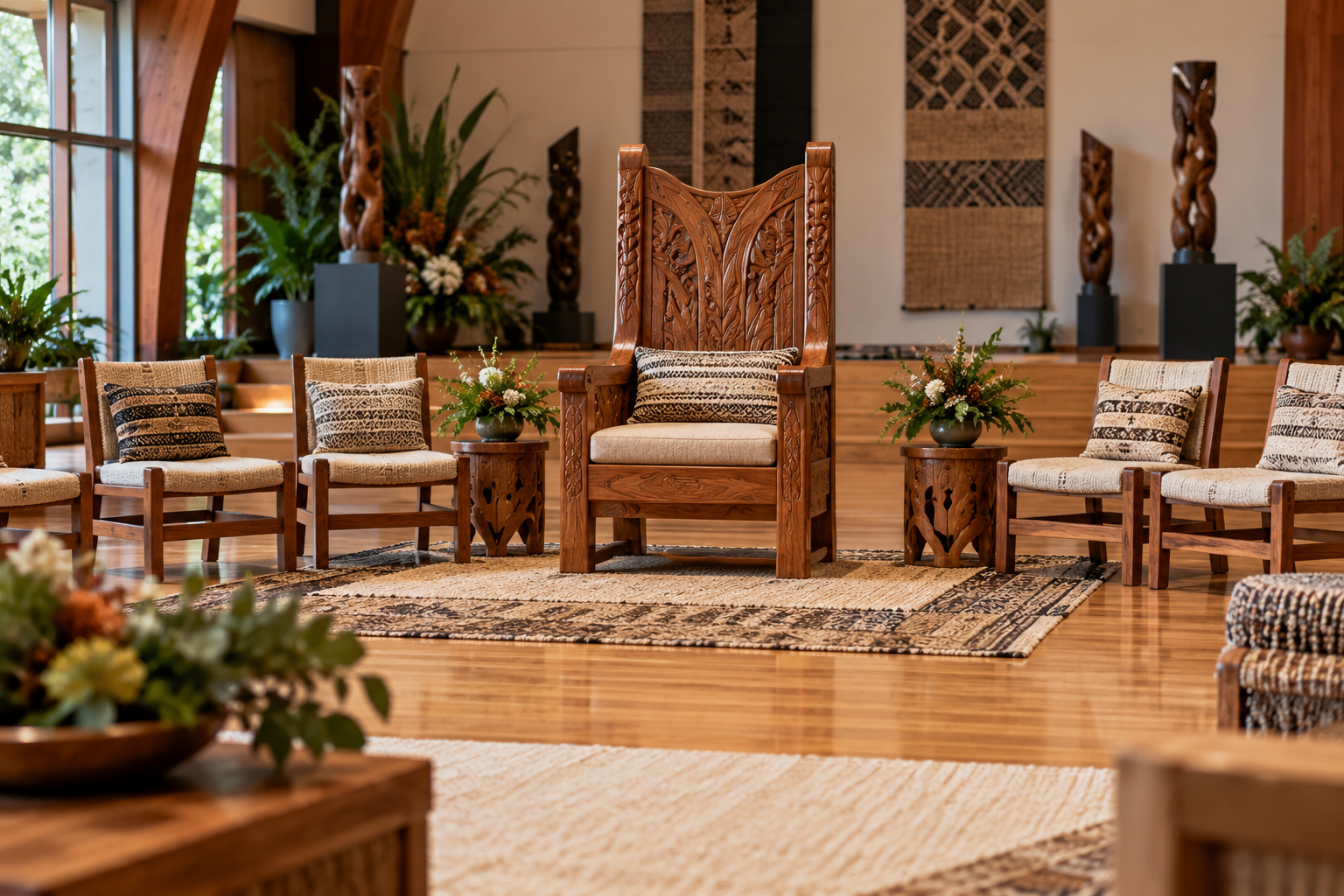
Ceremonial seating takes its meaning from the people and occasion around it. A place of honor may express service, responsibility, ancestry, leadership, or welcome in ways that cannot be understood from ornament alone. Festivals & Community Ceremonies begins with the guidance of those responsible for the event. Ask what the seat should be called, who uses it, how it is approached, and which symbols or arrangements are appropriate. An inherited object, a borrowed chair, and a new commission bring different histories and care responsibilities. This section considers practical access and comfort alongside ceremony, without assuming every community follows one model of royal display. Photography, captions, handling, and the return of an object may also require specific instructions. Documentation preserves both decisions and the people whose knowledge informed them. Whether planning a contemporary celebration or studying an established practice, avoid treating visually appealing motifs as interchangeable decoration. A respectful approach allows the seat's role to emerge through context, collaboration, and clear interpretation, connecting its presence with the relationships and obligations the ceremony is intended to recognize.
Throne Foundations
- Begin with the ceremony's organizers and community guidance rather than a generic royal theme.
- Identify who uses the seat and what that role means within this specific event.
- Confirm the appropriate name for the seating instead of automatically calling it a throne.
- Distinguish inherited objects, contemporary ceremonial furniture, and newly commissioned interpretations.
- Ask which colors, symbols, materials, and arrangements are appropriate to the occasion.
- Map the sequence of arrival, seating, speaking, presentation, and departure.
- Coordinate participant access and comfort with ceremonial expectations.
- Clarify whether photography and public interpretation require organizer review.
- Assign handling and care responsibilities for community-owned objects.
- Document decisions with the relevant people credited and their guidance accurately represented.
Royal Facts
- Ceremonial seating can express service, responsibility, honor, ancestry, or leadership depending on its context.
- Similar-looking seats do not necessarily have equivalent meanings across communities.
- A community's present practice may differ from a historical description or outsider's summary.
- A symbol appropriate to one occasion may be inappropriate to another.
- An honored guest's seat need not imply hereditary or political authority.
- The arrangement of surrounding seats can communicate relationships as clearly as the principal chair.
- A ceremonial object's ownership and its permitted handling are separate questions.
- A photograph can omit spoken explanations that establish the seat's meaning.
- A public event does not automatically make every part of its ceremony open for unrestricted reproduction.
- Local terminology can preserve distinctions lost in a broad label such as royal seating.
Royal Picks
- Prepare an organizer-approved brief describing the seat's role and permitted adaptations.
- Keep a ceremony sequence with named responsibilities for moving and preparing furniture.
- Use a layout reviewed by the people leading the event.
- Request guidance from relevant community representatives before reproducing specific symbols.
- Record the preferred terms and names for captions or event materials.
- Create a care record for inherited or borrowed ceremonial objects.
- Include access and comfort discussions early in planning.
- Use an approved image list when photographers need to understand restrictions.
- Keep contemporary design additions visibly documented as new work.
- Plan respectful storage and return arrangements with the object's custodian.
Behind the Throne
- An imported decorative motif can change the apparent meaning of a ceremony even when chosen only for visual appeal.
- A chair's position may matter more than its height or ornament within a particular event.
- An elder, leader, or honoree may have practical seating needs that a dramatic concept drawing overlooks.
- A borrowed object can connect generations through its documented use rather than through claims of extraordinary age.
- A modern commission can honor a tradition without pretending to be an inherited historical artifact.
- A photographer's caption can unintentionally assign political status that the ceremony does not confer.
- A community review can reveal meanings that are invisible to an outside decorator.
- A planning record should preserve disagreement and uncertainty rather than implying one person's view represents everyone.
- A seat shared in rotation may emphasize collective responsibility differently from a single permanent place of honor.
- The return of ceremonial furniture can be part of the occasion's responsibilities rather than ordinary event cleanup.
Throne Wonders
- Develop a community-designed seat with motifs selected through a documented collaborative process.
- Create a display explaining the makers and caretakers connected to a ceremonial chair.
- Explore coordinated seating that gives several community roles equal visual importance.
- Design removable occasion-specific panels approved by the event's organizers.
- Build a visual history from identified photographs and participants' accounts.
- Create an oral-history project about the people who maintain the furniture between ceremonies.
- Develop a new commemorative seat clearly dated and credited to its present-day makers.
- Compare ceremonial layouts within one documented tradition across several occasions.
- Design interpretive materials that use the community's preferred language and terminology.
- Preserve a construction and care record as part of the commissioned object's future history.
Throne FAQs
- Can any ornate chair serve a cultural ceremony? Ask the relevant organizers; suitability depends on the specific event and community meaning.
- Should I call the seat a throne? Use the term preferred by the people responsible for the ceremony.
- How do I choose appropriate symbols? Seek informed guidance within the relevant community rather than assembling motifs from unrelated image searches.
- Can historical descriptions guide a modern event? They can provide context, but confirm present practice with current organizers.
- What if participants need different seating? Discuss access and comfort early so the arrangement supports participation within the event's expectations.
- Can I photograph every part of the ceremony? Follow the organizers' instructions about photography, publication, and restricted moments.
- How should a new ceremonial chair be described? Identify its present-day makers, date, intended role, and the sources or guidance behind its design.
- Who should approve captions? Arrange review by the people responsible for the event and its interpretation.
- What records accompany a borrowed seat? Document custody, condition, handling, permitted use, care, and return responsibilities.
- How can a commission respect differing views? Use a clear consultation process and record whose guidance informed the final design.