
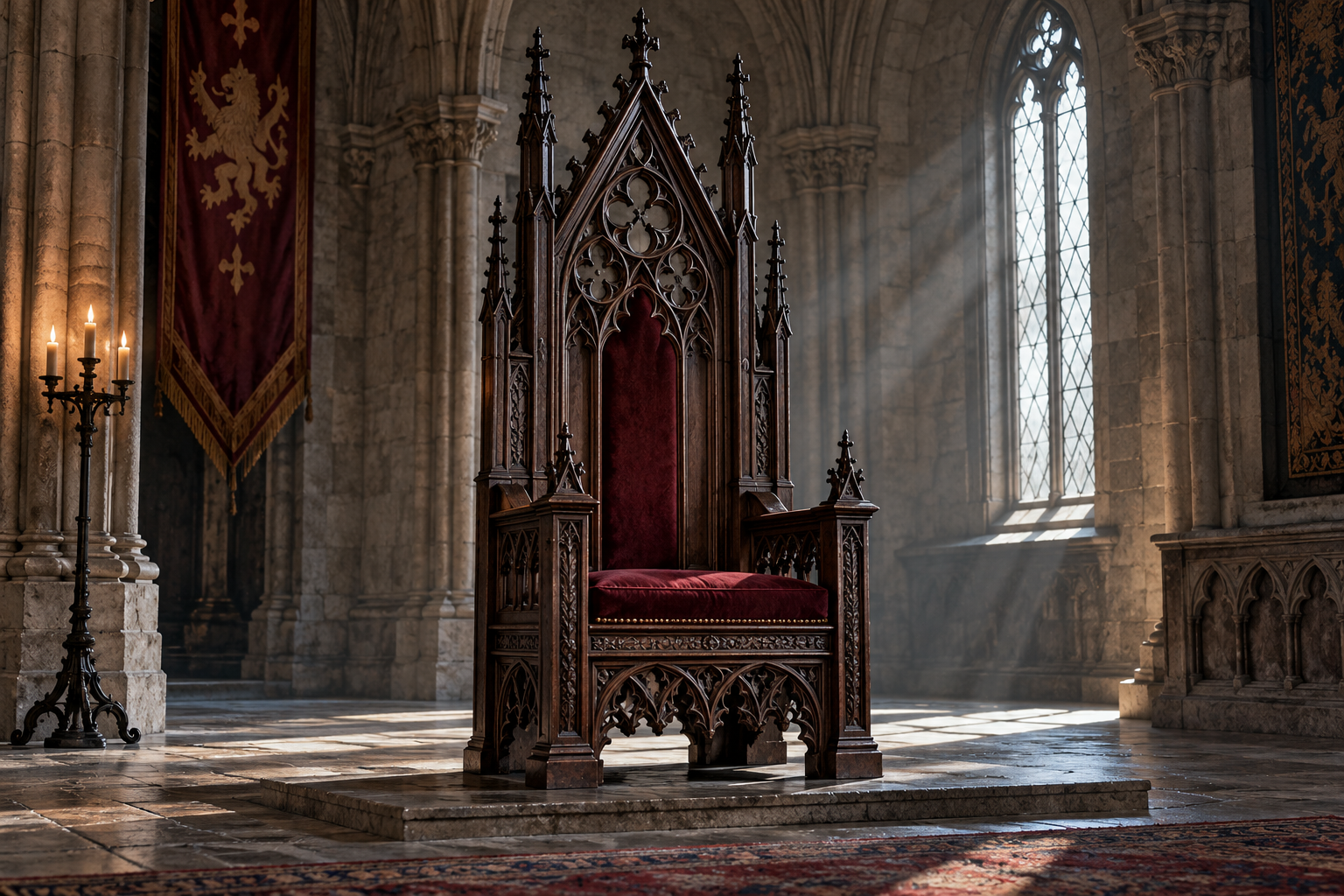
Pointed arches, pierced tracery, and tall vertical forms can give a throne an unmistakably Gothic character, but appearance alone does not establish its age. Gothic & Medieval Seating explores both historical references and later interpretations, keeping those categories distinct. Look at the relationship between chair and architecture: a back may suggest a window, a crest may echo a roofline, and repeated openings can make a substantial piece feel surprisingly light. Compare restrained timber seating with richly carved ceremonial designs, then consider how a contemporary fantasy throne adapts that vocabulary for a different story. Historical attribution belongs to specific objects and identified sources; Gothic-inspired design allows a wider creative conversation. This section helps you recognize the forms, describe their effect, and avoid confusing theatrical atmosphere with documented medieval manufacture. Consider the occupied silhouette, the room around it, and the balance between solid surfaces and open space. Whether you are studying an artifact or developing a modern concept, the most compelling result comes from understanding how the visual language works before adding another layer of dramatic ornament.
Throne Foundations
- Distinguish surviving medieval furniture, later Gothic Revival work, and new fantasy interpretations.
- Pointed profiles can guide the backrest outline without dictating the sitting position.
- Tracery describes ornamental frameworks, often adapted from window patterns into furniture.
- Paneling divides a broad back into smaller framed fields.
- Openwork removes material to create visible patterns and negative space.
- Crests and finials finish the upper silhouette; assess their scale together.
- A Gothic vocabulary can appear in restrained furniture as well as elaborate thrones.
- A dark finish is a color choice, not evidence of medieval manufacture.
- Carved heraldry needs an identified source when presented as historic.
- For a new throne, develop the seat and supporting frame before extending architectural ornament.
Royal Facts
- The V&A identifies pointed arches as a characteristic feature of Gothic architecture.
- The Met’s Gothic Windsor armchairs adapt tracery to an open-backed chair form.
- The Met places those Windsor examples within eighteenth-century Gothic taste.
- A Gothic Revival object is later than the medieval examples informing its design.
- Tracery can be carved, pierced, or suggested through applied detailing.
- An upholstered panel and an openwork back create different visual densities.
- A pointed crest can be decorative without making the whole chair pointed in profile.
- A crown carved on a chair does not establish a documented royal owner.
- Architectural ornament can conceal the boundaries between furniture components.
- Historic appearance does not establish a modern throne’s materials or construction.
Royal Picks
- For an airy interpretation, study the Met’s Gothic Windsor openwork rather than copying a solid-backed throne.
- For architectural vocabulary, use the V&A’s Gothic introduction to distinguish motifs.
- Compare a single pointed back panel with several smaller tracery fields.
- Choose an ornament sample showing carving depth before approving the full back.
- Test a full-size crest outline against the intended ceiling and backdrop.
- Compare stained timber with painted timber using the actual proposed substrate.
- Select upholstery that leaves the defining back profile readable.
- For a mobile display, request documented connections for projecting pinnacles.
- Use a side drawing to check how carved arm terminals project toward the occupant.
- Build a reference board labeled by date so revival objects remain distinguishable.
Behind the Throne
- Trace each pointed motif back to a named reference instead of calling all angular furniture Gothic.
- Check whether tracery is structural framing or applied ornament.
- Review carved edges where clothing and hands meet the chair.
- Openwork needs a rear view because its design is visible from both sides.
- Keep ornament clear of the usable entrance between the arms.
- Inspect the junction between the crest and back rather than judging the crest separately.
- A heavily distressed finish should be described as a modern effect when newly applied.
- Agree which heraldic details are invented and which reproduce an identified emblem.
- Record removable ornament in transport drawings, including how it is protected.
- For period claims, seek provenance and dating evidence beyond decorative resemblance.
Throne Wonders
- An open tracery back can cast patterned shadows across a plain wall.
- A narrow pointed crest can suggest height without a massive solid back.
- Repeated arches can connect the arms, back, and surrounding set visually.
- One contrasting upholstered field can clarify an otherwise complex silhouette.
- A pale Gothic-inspired throne offers a different mood from familiar dark fantasy seating.
- A restrained carved border can suggest architectural detail without becoming a miniature building.
- Changing the negative spaces can transform a back while retaining its outer outline.
- A rear-lit openwork design can become a focal point after daylight fades.
- An original emblem can give a fantasy ruler identity without borrowing historic heraldry.
- Comparing medieval references with revival furniture reveals different interpretations of the same vocabulary.
Throne FAQs
- Is Gothic Revival furniture medieval? No. It is later work interpreting medieval references.
- Does Gothic always mean black wood? No. Color and finish are separate design decisions.
- What is tracery on a throne? An ornamental framework or pattern adapted into the back, panels, or other details.
- Must a Gothic throne be heavily carved? No. A clear pointed profile or restrained openwork can carry the concept.
- Does a tall back prove historic authenticity? No. Dating requires object-specific evidence.
- Can a Gothic design include upholstery? Yes. Consider how the padded fields relate to the surrounding framework.
- Should both faces of an openwork back be finished? Agree the rear treatment when it will be visible through the pattern.
- Can I invent heraldry for a fantasy throne? Yes. Label it as original worldbuilding rather than historic royal arms.
- How do I choose carving depth? Compare a physical sample under the lighting planned for the completed piece.
- What should a modern replica caption include? Identify the source object and explain that the displayed piece is a later reproduction.