
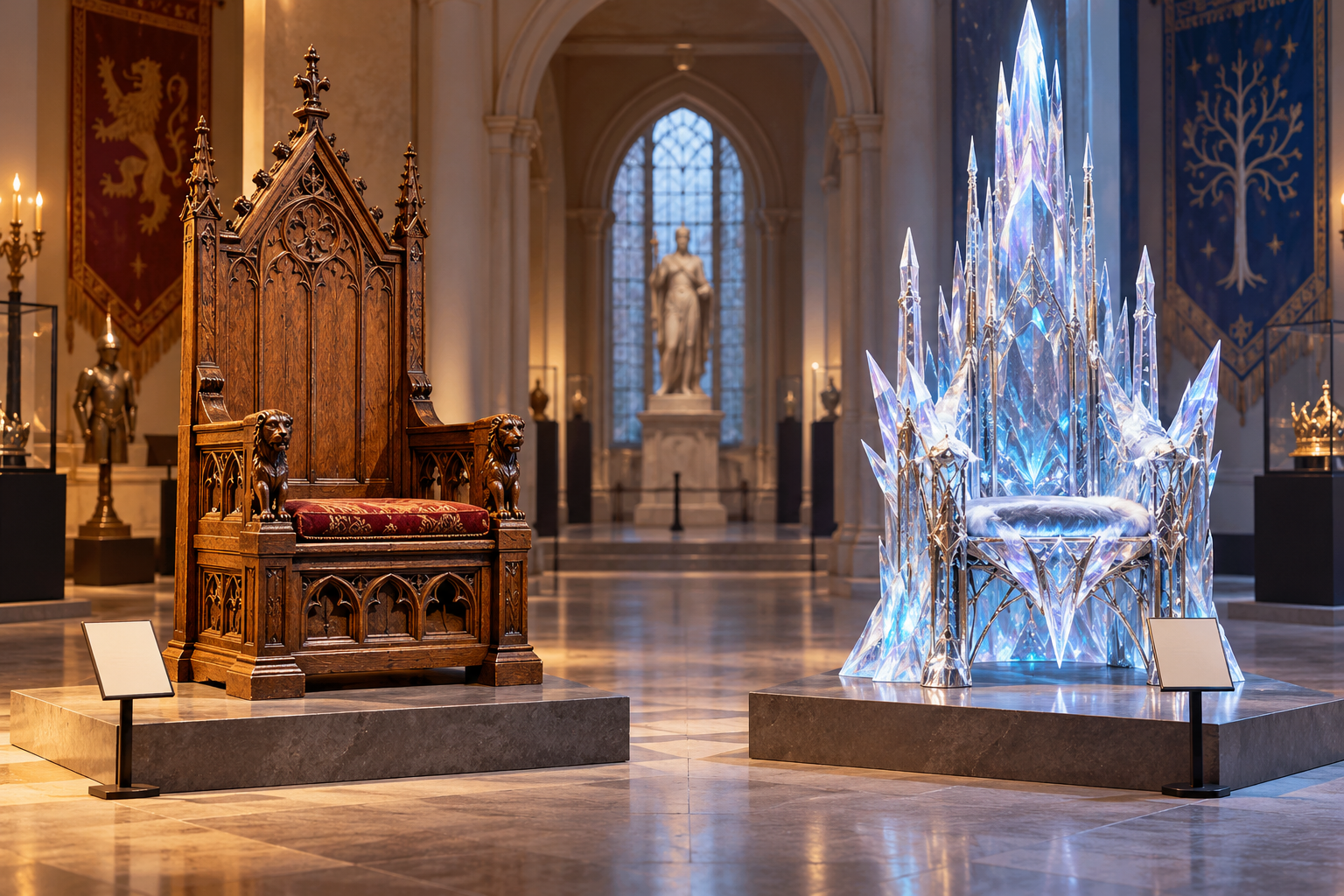
Famous throne names do not always identify one straightforward object. A title can refer to an institution, several ceremonial chairs, a lost seat, a legend, or different versions of a fictional design. Iconic Seating Index helps untangle those identities. Begin with a named entry and its classification, then follow aliases, dates, sources, locations, and related replicas or reconstructions. Separate manufacture from later use, and distinguish an object's current appearance from changes made across its life. Fictional entries need equal precision: a novel, screen adaptation, game, and licensed replica can share a name without sharing every feature. This section keeps uncertainty visible rather than combining plausible details into a misleading complete story. Inventory numbers, source editions, image captions, and dated location checks help maintain a traceable record. Use the index to discover relationships between named thrones and the materials, components, or symbols explored elsewhere in Thronepedia. The result is a clearer starting point for research, allowing familiar names to open specific documented histories and invented worlds instead of becoming interchangeable examples of royal grandeur.
Throne Foundations
- Identify each throne by name and record aliases without merging unrelated seats.
- Classify the entry as surviving object, lost object, legend, fictional creation, or modern interpretation.
- Separate manufacture date, period of use, and later collection history.
- Identify the source work and version for fictional entries.
- Distinguish a chair's own name from an institution named after a throne.
- Record current location only when supported by an identified source.
- Note reconstructions and replicas as related objects rather than identical originals.
- Keep disputed attribution visible within the record.
- Link materials, symbols, and components to their dedicated reference sections.
- Use source dates to recognize when location or display information needs rechecking.
Royal Facts
- Several physical objects can share a ceremonial title.
- A throne associated with a ruler may have been made before or after that ruler's lifetime.
- A fictional seat can differ between a novel, adaptation, game, and licensed replica.
- A surviving throne may contain later upholstery, finish, or structural repairs.
- A historic image documents a depiction rather than necessarily the complete physical object.
- A legendary throne may be known through narrative without a surviving artifact.
- An object's collection location and original setting can be far apart.
- A named seat can acquire new meanings through later ceremonies and retellings.
- A reconstruction's confidence can vary between well-documented and conjectural details.
- A replica's display location does not establish the original object's whereabouts.
Royal Picks
- Use a structured record with identity, classification, date, context, location, and sources.
- Preserve accession or inventory identifiers where available.
- Record alternate names with the sources that use them.
- Keep book, screen, and game versions in separate linked records.
- Use identified collection pages for surviving-object research.
- Consult original works for fictional descriptions.
- Attach a dated location check to travel-related notes.
- Create a relationship map for originals, replicas, and reconstructions.
- Keep disputed claims in a clearly attributed note.
- Use images with captions identifying which version they show.
Behind the Throne
- A famous name can cause several related objects to be confused in popular summaries.
- A later ceremonial use can become better known than the chair's original commission.
- A museum label may cautiously date an object that a promotional article describes with false precision.
- A screen design can dominate public memory even when its source text describes something different.
- A replica can preserve a documented earlier appearance no longer present on the altered original.
- A location claim can become outdated when an object enters storage, travels, or changes galleries.
- An institutional use of the word throne can persist without reference to one particular chair.
- A record should distinguish direct evidence from a tradition of association.
- A missing object may still have a research history through inventories, images, and descriptions.
- An accurate index preserves relationships and uncertainty instead of forcing every famous name into one simple story.
Throne Wonders
- Map the documented journey of one throne between original setting and later collections.
- Compare a fictional seat across identified adaptations.
- Create an original-versus-replica relationship diagram.
- Trace how one ceremonial title became attached to several chairs.
- Build an alterations timeline using dated images.
- Explore a lost throne through surviving written descriptions.
- Compare a legendary narrative with clearly labeled artistic interpretations.
- Create a name index that preserves regional spellings.
- Document how collection labels changed as scholarship developed.
- Build a research trail connecting a named throne to materials and symbols entries.
Throne FAQs
- Does every famous throne have one identifiable original? No. Names can refer to several objects, institutions, legends, or different fictional versions.
- How should a replica be indexed? Give it a distinct record linked to its reference object and identify maker, date, and interpretive differences.
- What date belongs in an entry? Separate manufacture, documented use, alteration, and collection dates rather than compressing them into one number.
- Can a legend be included without an artifact? Yes, when classified as narrative tradition and supported by identified sources.
- Why record inventory numbers? They help distinguish a specific object from similarly named chairs or replicas.
- How do I handle book and screen differences? Use separate version records and cite the work or production behind each detail.
- Can current location be assumed permanent? No. Date the source and recheck official information when planning a visit.
- What if attribution is disputed? Identify the competing interpretations and evidence without presenting one uncertain claim as settled.
- Are popular nicknames useful? Yes, as searchable aliases with context, provided they do not replace more precise identification.
- What makes the index reliable? Clear classification, identifiable sources, version control, qualified claims, and relationships between related objects.