
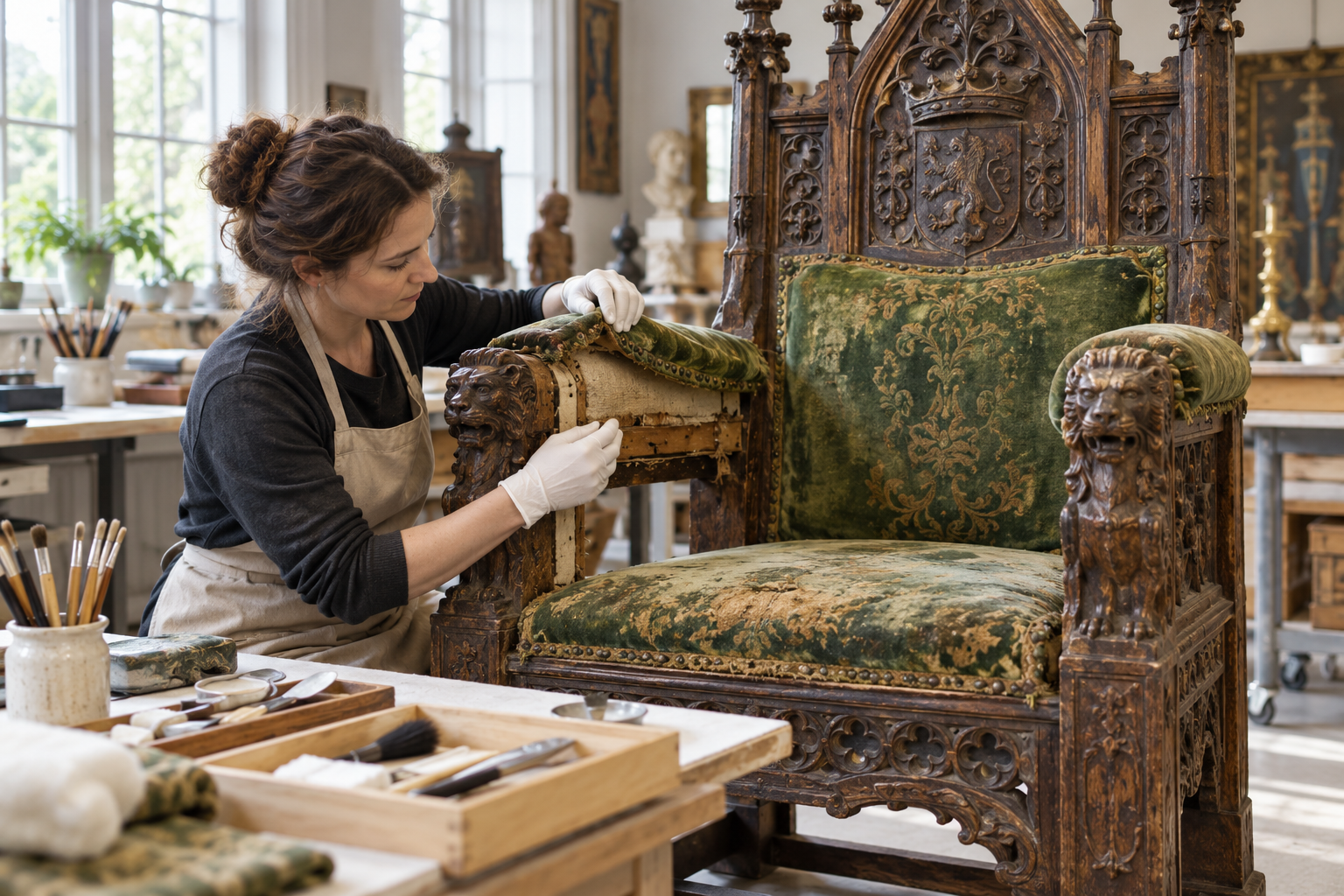
Every throne carries a material history, from the joints hidden beneath its upholstery to the finish worn by years of handling. Caring for it begins with understanding what is present and what has changed. Durability, Maintenance & Refurbishment explores routine attention, condition records, repairs, and the decisions surrounding historic or personally significant seating. Learn to separate a cosmetic mark from a problem that needs further examination, identify the actual materials before choosing cleaning methods, and document an object before dismantling or refinishing it. Restoration, conservation, repair, and restyling pursue different goals; naming the intention helps protect evidence that might otherwise disappear beneath a fresh surface. A modern scenic throne may need replaceable ornament and a touch-up record, while an inherited chair may call for qualified conservation advice. Discover why photographs, retained fragments, product information, and repair notes become part of stewardship. The aim is more than making an old throne look new. It is preserving useful knowledge, supporting appropriate future use, and making thoughtful decisions about which traces of its life deserve to remain visible.
Throne Foundations
- Create a condition record before cleaning or repair, using overall photographs and close views of existing damage.
- Identify each surface separately: painted wood, exposed timber, gilding, metal fittings, upholstery, and applied ornament may need different care.
- Routine care aims to prevent deterioration; restoration changes an object to recover a chosen appearance or function.
- Conservation considers the significance and surviving evidence of an object when deciding what intervention is appropriate.
- Follow the maker’s care instructions for a contemporary throne with documented materials and finishes.
- An older or unidentified surface needs assessment before choosing a cleaner or coating.
- Loose joints and unstable supports should be reviewed before the chair returns to occupied use.
- Flaking, powdering, or lifting decoration calls for a different response from ordinary surface dust.
- Plan handling around sound structural areas and the throne’s condition, rather than gripping projecting ornament.
- Keep care notes with the object so future owners or repairers know what has already been done.
Royal Facts
- An original finish can be part of a historic chair’s surviving evidence, rather than merely an old covering to replace.
- Unfinished wood and coated wood should not automatically receive the same cleaning treatment.
- A commercial furniture polish is not a universal treatment for every wooden surface.
- Applied ornament can loosen independently of the main frame.
- Upholstery damage may involve the covering, padding, support, or several layers together.
- A visible repair can belong to a different period from the surrounding construction.
- A missing component and a damaged surviving component present different restoration decisions.
- Before-and-after photographs are more informative when taken from matching viewpoints.
- A modern replacement should be documented rather than silently presented as an original part.
- Cleaning, repairing a joint, replacing upholstery, and refinishing are separate interventions with different effects.
Royal Picks
- Use a condition notebook that separates observations from assumptions about the cause of damage.
- Keep dated photographs of joints, feet, carved projections, and frequently handled surfaces.
- For contemporary upholstery, retain the covering’s manufacturer reference and cleaning instructions.
- For routine dusting of a known stable surface, select tools suited to the maker’s stated care method.
- For fragile decorative surfaces, seek a conservator’s assessment before buying a cleaning product.
- Store detached pieces in clearly labeled protective containers while awaiting an agreed repair approach.
- Use a component diagram to identify the location and orientation of parts removed during authorized work.
- Ask a restorer for a proposed treatment description that distinguishes cleaning, repair, replacement, and refinishing.
- For a valuable historic chair, choose relevant conservation expertise rather than a service based solely on making furniture look new.
- Keep an approved repair sample when a contemporary painted prop may need repeated finish matching.
Behind the Throne
- Describe movement at a joint precisely: where it occurs, when it was noticed, and whether it has changed.
- Do not force a detached carving back into place before its original connection has been understood.
- Photograph a damaged area before covering it with a repair or replacement material.
- For mixed finishes, map their boundaries so work on one surface does not unintentionally affect another.
- Decide whether a historic piece will remain a display object before assuming restoration should return it to everyday seating.
- Ask how a proposed treatment will affect maker marks, earlier repairs, and evidence beneath the upholstery.
- Record any replacement fabric and what information survives about earlier coverings.
- Review the throne’s location if recurring damage relates to nearby movement, handling, water, or strong light.
- Agree on what should remain visibly aged instead of allowing ‘restoration’ to mean an unspecified fresh appearance.
- At handover, request treatment notes and revised handling or care instructions for the repaired piece.
Throne Wonders
- The underside of a chair can preserve labels, marks, and construction clues absent from its decorated front.
- A historic throne’s finish can hold evidence of changing tastes through later painted or coated layers.
- Close photographs can reveal that apparently continuous ornament was assembled from separate pieces.
- An old repair can tell a story about how a chair was valued and kept in service.
- A sympathetic repair can preserve the visual character of a contemporary throne without replacing every marked surface.
- A restoration diary can reveal the amount of hidden work behind a seemingly small visible change.
- A preserved fragment can inform a replacement detail more reliably than an invented symmetrical guess.
- Examining upholstery as layers can uncover a different history from studying the frame alone.
- The V&A’s account of conserving Marie Antoinette’s chair shows how treatment choices depend on a particular object’s construction.
- A careful condition photograph can become a useful reference years after the person who took it has forgotten the original detail.
Throne FAQs
- Should I polish every wooden throne? No. Identify the surface and follow appropriate care guidance; the Canadian Conservation Institute cautions against general restoration mixtures on museum wooden objects.
- Can I wet-clean unfinished wood? The Canadian Conservation Institute advises against wet cleaning unfinished wood. Do not treat bare timber as though it has a protective coating.
- What should I do about flaking paint or loose gilding? Avoid routine brushing or rubbing that could disturb it and obtain advice from a conservator experienced with the surface.
- Should an old finish be stripped before restoration? Not automatically. Discuss its condition and significance first; removing a historic finish is an irreversible change to surviving material.
- Can a throne with a loose joint still be used? Arrange an appropriate assessment before returning it to occupied use; covering the movement with upholstery does not resolve the connection.
- What if a small carved piece breaks off? Keep and label the fragment, photograph its location, and avoid an improvised repair before the connection and suitable treatment are assessed.
- Is reupholstering only a matter of changing fabric? No. The covering may conceal padding, support, fasteners, and earlier material that should be examined and documented.
- How can I describe the result I want from a restorer? Identify whether the priority is continued use, preservation, display appearance, or a particular combination, then agree the proposed treatment.
- Should every old mark disappear after restoration? No. Decide which marks are damage requiring treatment and which are acceptable evidence of age or use.
- What documentation should accompany completed work? Request photographs, the treatment description, replacement material details, and any changes to recommended handling, use, or care.
Maintaining Statement Seating for Events and Displays
Keep statement seating ready for its next appearance. Build a practical care plan around actual materials, repeated handling, condition records, accessible repairs, and the operating life of an event or display installation.