
Look Beneath the Royal Surface
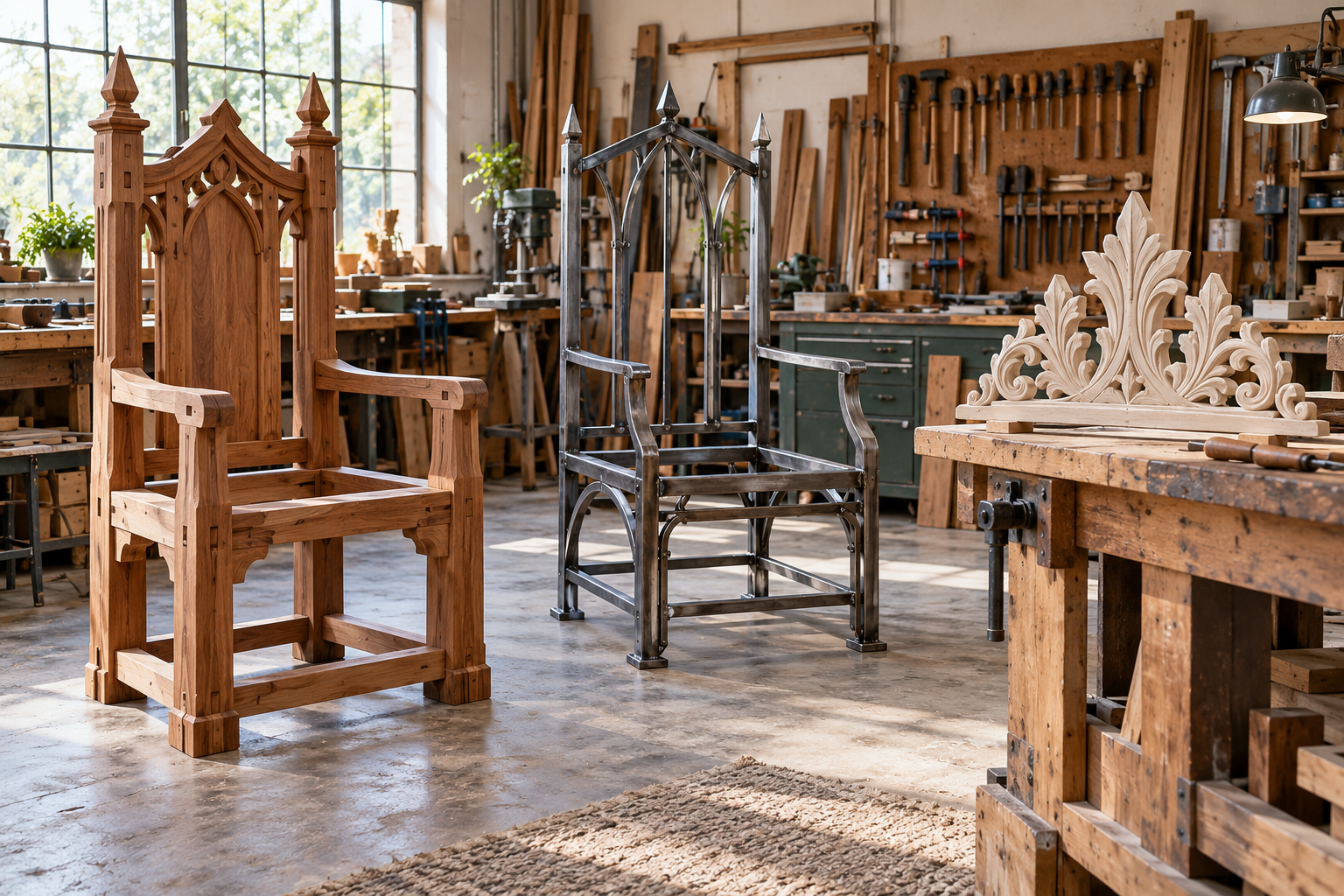
A throne can look like carved stone and contain no stone at all. Another can appear to be solid metal while combining a supporting frame, shaped ornament, upholstery, and a metallic finish. A third may celebrate visible timber, making the grain part of the design. The first impression matters, but understanding the construction beneath it makes comparison far more useful.
Wood, metal, and scenic materials are not three simple levels of quality. They offer different possibilities for structure, texture, fabrication, transport, maintenance, and visual storytelling. The right choice depends on what the throne must do and how it will be seen. This guide separates those questions so you can discuss a complete design with a maker, compare proposals intelligently, and avoid confusing an attractive material label with a finished specification.
Throne Foundations
- Identify the intended use before comparing materials.
- Separate the supporting system from decorative forms.
- Describe upholstery as part of the complete construction.
- Ask where each stated material occurs in the object.
- Review connections between different material systems.
- Test finish on representative substrates and shapes.
- Consider viewing distance when evaluating scenic effects.
- Plan approved disassembly and reassembly.
- Discuss repair access before fabrication is complete.
- Compare equivalent complete proposals rather than material labels.
Royal Facts
- A stone-like surface does not establish that the object is stone.
- One throne can combine timber, metal, upholstery, and cast ornament.
- A supporting frame and a decorative shell can be separate components.
- Wood grain can contribute directly to a throne's visual identity.
- A metal frame can remain hidden beneath another surface treatment.
- A scenic effect can be designed for a particular viewing distance.
- A shaped finish sample reveals different information from a flat swatch.
- Detachable ornament can change transport requirements.
- A repairable decorative part is not necessarily a structural component.
- A material name alone does not establish a finished chair's suitability.
Royal Picks
- Request a component-level material description.
- Compare a visible frame sample with the proposed upholstery.
- Use a representative scenic texture sample for camera tests.
- Ask for a drawing of important material junctions.
- Keep an approved finish sample with the project record.
- Review the actual assembled and packed dimensions.
- Obtain the maker's approved handling information.
- Record fabric and finish references for future work.
- Ask which decorative components can be replaced separately.
- Consult technical material references when discussing a fabrication brief.
Behind the Throne
- The same visual mass can be produced through very different construction strategies.
- A quiet finish can make complicated relief easier to understand.
- Material transitions often determine whether mixed construction looks integrated.
- An accessible fastener may simplify later ornament replacement.
- A surface designed for distant viewing may behave differently in close-up.
- Packing needs can change a material's practical appeal.
- A refined metal outline can be softened by generous upholstery.
- Timber can communicate formality without elaborate carving.
- A finish system should be reviewed beyond its color name.
- Future maintenance belongs in the original design conversation.
Throne Wonders
- Combine a natural wood frame with a restrained cast crest.
- Use a metal structure to support an airy geometric silhouette.
- Create a scenic stone effect around a separately specified seat.
- Let timber grain replace some decorative surface pattern.
- Develop interchangeable panels for several original fantasy settings.
- Use selective sheen to reveal a carved edge.
- Pair industrial metal lines with warm fabric.
- Create a crystal-like visual treatment for a display concept.
- Design a removable upper ornament that changes the chair's character.
- Make a material junction an intentional decorative feature.
Throne FAQs
- Is solid wood always the best option? The appropriate construction depends on the complete intended use and design.
- Does a metal frame prove a chair is suitable? No. Evaluate the completed specification and documented intended use.
- Can a throne only look like stone? Yes. Scenic systems can create that appearance.
- Should supporting and decorative parts use the same material? Not necessarily; mixed construction can assign different roles clearly.
- Why request finish samples? They show how the proposed system looks on a representative surface.
- What matters for a filmed prop? Consider camera distance, lighting, handling, continuity, and its intended physical use.
- Can ornament be removable? It can be designed that way, with appropriate connections and documentation.
- How do I compare delivery requirements? Use actual dimensions, packing, weight, route, and handling information.
- What should I retain for repairs? The specification, material references, finish samples, and maker's care guidance.
- What is the best material choice? The one that supports a coherent construction strategy for your particular throne.
Separate Supporting Structure from Decorative Form
Think of a throne as several related systems. The supporting structure establishes how the piece serves its intended use. Decorative forms create the crest, relief, wings, or architectural mass. Upholstery provides contact surfaces and part of the visual identity. The finish connects those elements through color, texture, and sheen. One material may serve several roles, or each role may use a different material.
That distinction is especially useful when comparing functional furniture with a scenic object. A decorative shell can create an extraordinary outline while remaining separate from the seat beneath it. Ask the maker which components perform which jobs. A material sample can show a surface effect, but it does not establish the completed chair's structural suitability. Understanding the division of roles also helps with later repairs, because a damaged ornament may require a different response from a problem in the supporting frame.
What Wood Brings to a Throne
Wood offers a strong visual connection between material and workmanship. Grain can run through a shaped rail, carving can produce relief within a surface, and a stained or clear-finished frame can make its construction part of the chair's character. A timber throne can feel formal, rustic, sculptural, or restrained depending on its proportions and finish. It does not need heavy carving to establish presence.
Describe the wood components precisely when comparing proposals. Solid timber, veneers, and wood-based panels have different roles and should not be collapsed into one vague phrase. Ask about the visible species, the intended appearance, and how the maker approaches the relevant construction and use conditions. For technical background on wood as an engineering material, the USDA Forest Products Laboratory publishes its Wood Handbook; applying material knowledge to a particular throne remains a design task. USDA Forest Products Laboratory: Wood Handbook
What Metal Makes Possible
Metal can support a throne concept built around slender lines, geometric frames, curved profiles, or a deliberately industrial character. It can also sit beneath decorative work, contributing to a mixed-material design whose visible surface has another appearance entirely. A metal throne does not need to resemble a rigid cage or a collection of blades; broad upholstered areas and refined detailing can give it a softer presence.
Ask which metal is proposed, where it occurs, and how the final surface will be treated. A polished finish, a coating, and an intentionally textured surface create different visual and maintenance briefs. Review how the frame meets upholstery, floor contact points, and decorative components. The usefulness of the material comes from those design decisions rather than from the word 'metal' by itself. A coherent proposal should explain the completed object and its expected care.
The Creative Role of Scenic Materials
Scenic work can create the visual language of stone, weathered metal, bark, crystal, or carved architectural mass without reproducing the original material throughout. Shaped foam, cast elements, sheet materials, and layered finishes may contribute to the illusion. This can be valuable when the throne's main job is to communicate a world on stage, in a themed display, or through a camera.
Scenic materials deserve a clear brief about viewing distance and handling. A surface that convinces from across a theater may need a different treatment for an intimate camera close-up. An ornament intended only for display has another role from a frequently touched arm detail. Evaluate actual samples and representative views. If the object will be occupied, its intended seating provision must be specified separately; the success of a painted illusion does not answer that practical question.
Mixed Materials Often Create the Most Useful Answer
A throne does not need to declare loyalty to one material. A timber seat frame might carry cast decorative panels. A metal supporting system might sit behind a carved-looking scenic back. An upholstered chair can use removable ornament to change its character between projects. Mixed construction allows the designer to assign each visual and practical task to an appropriate component.
The interesting questions occur where systems meet. How does the ornament connect? Can it be removed without disturbing the upholstery? Does the finished edge reveal an unwanted change of material? Who supplies the complete finish treatment so adjoining surfaces read as one design? These relationships can determine whether the throne feels integrated or assembled from unrelated parts. Discuss them early, when the maker can still adjust the design rather than disguise awkward junctions after fabrication.
Use Finish to Unify, Not Obscure, the Design
Finish can give a throne warmth, depth, contrast, or a completely imagined material identity. A matte surface can quiet a complex form. Selective sheen can reveal a ridge or carved edge. A metallic treatment can connect components made from different substrates. Yet the finish is not simply the final color applied after every other decision is complete.
Review the proposed finish on the actual material system where practical. A flat sample helps with color, while a shaped sample can reveal how highlights move across relief. Compare the result in the intended room or production lighting. Ask what care and touch-up methods the maker specifies. A finish that looks excellent at handover is more useful when its maintenance and repair are understood. Keep any sample approval connected to the complete coating proposal rather than a color name alone.
Consider Transport and Reassembly as Design Questions
Construction affects how a throne travels. The assembled outline, weight, protective packing, and approved detachable components all influence the route from workshop to destination. A visually massive scenic object may be built in sections; a comparatively modest chair may still have a difficult high crest. Material labels do not replace the actual measurements and handling information.
Ask the maker to identify which components separate and how the object is restored to its intended condition after transport. Keep documentation with the piece, especially when several teams will install it over time. Surface protection matters as well as structural handling: a delicate painted effect can need attention even when the supporting frame is robust. Planning those needs at the design stage can preserve visual ambition while making the finished throne more manageable for its real setting.
Compare Repair and Future Changes
A throne's useful life may include new upholstery, a different event theme, replacement trim, or repair after handling. Think about which parts are likely to change. A decorative crest might be intentionally replaceable, while a structural connection needs another level of consideration. Access to components can matter as much as the initial material choice.
Ask for enough information to understand the maker's repair approach. Can a damaged surface be matched? Are fabric and finish references retained? Which parts should be returned to the workshop, and which routine tasks are appropriate for the owner? Avoid treating every alteration as an easy cosmetic update. A design that allows thoughtful maintenance can remain expressive without requiring the whole object to be replaced when one visible element needs attention.
Choose a Construction Strategy, Not a Material Slogan
The strongest comparison describes the same intended throne in each proposal: who uses it, where it stands, how it is viewed, how it travels, and what care it needs. Then evaluate what wood, metal, scenic materials, or a combination contribute to that brief. Appearance, fabrication, handling, and future repair become parts of one decision.
A timber throne may celebrate carving and grain. A metal-framed seat may express a precise geometric idea. A scenic throne may bring an impossible fictional material convincingly into view. None is automatically the right answer for every project. Choose the construction strategy that makes the intended object clear, workable, and visually coherent, and let the material description explain that strategy rather than substitute for it.
Related Articles
Color and Upholstery for Statement Seating
Color and upholstery can transform the character of statement seating. Explore palettes, texture, pattern scale, seams, trim, and real lighting to create a coherent seat for interiors, events,…

Commissioning Custom Seating: Turn an Idea into a Clear Design Brief
A striking idea becomes a successful commission through clear decisions. Learn how to turn inspiration into a practical throne design brief, collaborate with a maker, review samples and…
Designing Statement Seating: Form, Comfort, and Fit
A memorable seat needs more than a striking silhouette. Explore how form, usable dimensions, comfort, materials, and setting work together to turn an imaginative chair into a convincing…