
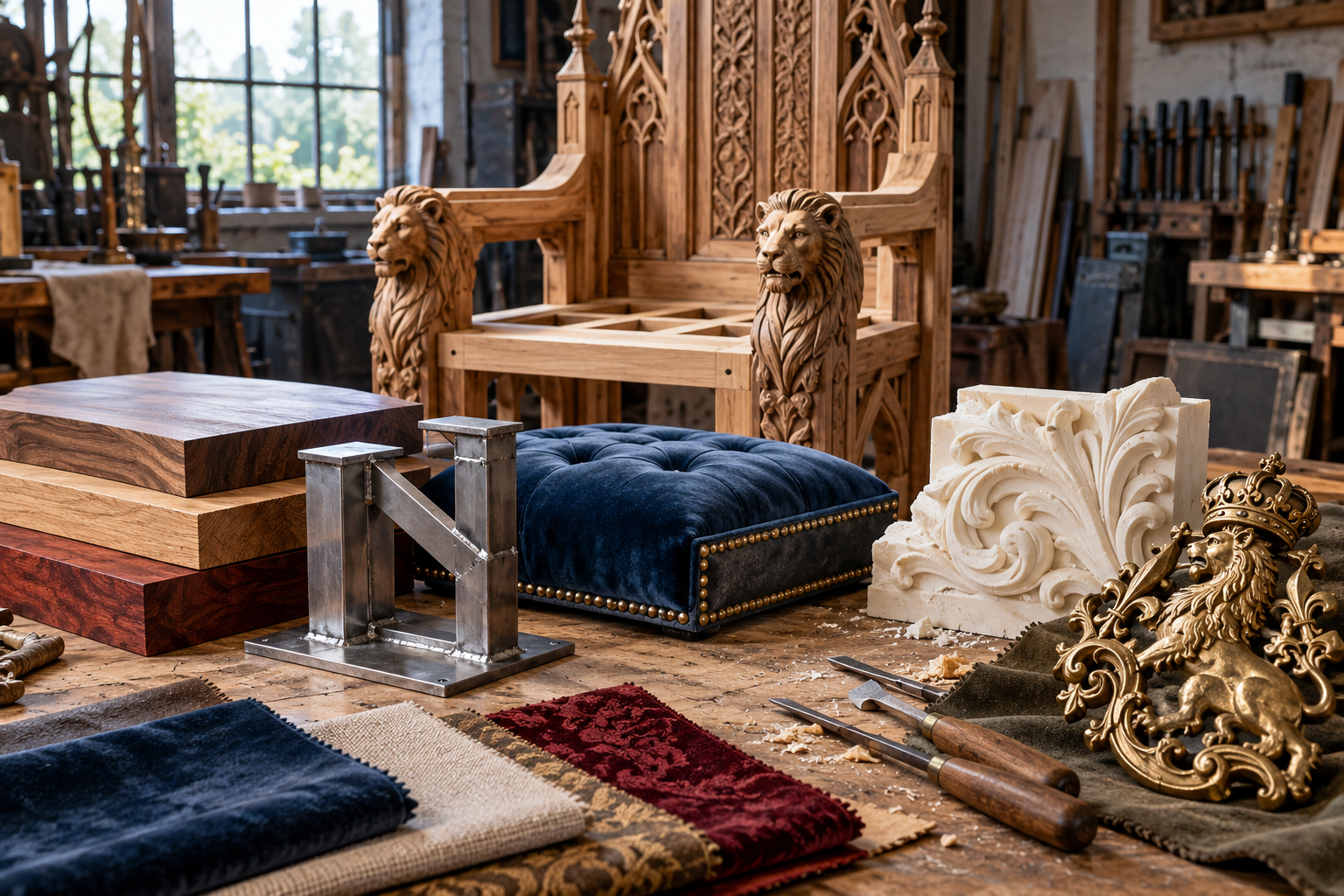
What looks like carved stone may be a lightweight scenic shell, and a gleaming gold surface may cover timber rather than precious metal. Throne materials deserve a closer look than their first impression allows. This section explains how solid wood, metal frameworks, upholstery, foam, resin, composites, and surface finishes contribute different qualities to royal and fantasy seating. Separate the material that carries the load from the decorative layers that create its appearance. Compare weight, repair access, texture, transport demands, and care requirements in the context of the actual use. A throne intended for a gallery, an outdoor garden, a touring production, or daily household seating raises different questions, even when the designs look similar. Learn why exact product information matters for modern fabricated materials and why historic objects may contain several generations of repairs. Rather than declaring one substance universally superior, Materials & Structural Concepts helps you understand the complete assembly. That knowledge makes it easier to interpret specifications, discuss alternatives with a maker, and recognize when a convincing material illusion is serving the design beautifully.
Throne Foundations
- Separate the structural frame, decorative surfaces, padding, and covering when describing a throne’s materials.
- Solid wood identifies a material form, but the species, dimensions, joints, and design still need separate explanation.
- Veneer is a thin surface layer of wood over a substrate; ask what supports the visible face.
- Plywood is a layered wood panel that may be used within a frame, seat, or decorative assembly.
- Metal can form a load-bearing framework, applied ornament, or a thin exterior skin; identify which role it serves.
- Upholstery fabric covers an underlying assembly; its appearance does not describe the cushion or seat support.
- Leather and imitation leather should be identified separately, with care instructions appropriate to the actual covering.
- Scenic foam can create carved-looking volume around a separate structure; do not infer seating capacity from its finish.
- Cast resin describes a manufacturing approach, not one universal material with identical properties.
- A composite combines constituent materials; request the specific system rather than treating ‘composite’ as a complete specification.
Royal Facts
- Wood grain visible on a surface does not establish that every component is solid timber.
- A metallic appearance can come from paint, leaf, plating, sheet metal, or solid metal parts.
- The material beneath a decorative coating may differ from the material the coating imitates.
- Two thrones with similar external finishes can have different frame materials and weights.
- An upholstered chair can combine several textiles, foams, backing materials, and attachment systems.
- A material name does not specify the thickness of the component made from it.
- A hollow metal member and a solid metal bar are different construction forms even when made from the same metal.
- A veneer’s supporting substrate is part of the material description, even when it is hidden from view.
- The same coating can look different on smooth and heavily textured substrates.
- A material suitable for one component is not automatically suitable for every part of the throne.
Royal Picks
- Request a materials schedule with separate entries for the frame, panels, ornament, seat support, padding, and covering.
- For wood surfaces, compare a representative sample of the proposed species and finish together.
- For veneered panels, request a sample showing both the face and the substrate at an edge.
- For metal frames, ask for the material and section description rather than a generic ‘metal construction’ label.
- For fabric selection, compare swatches under the intended room lighting and read the supplier’s care information.
- For leather-look coverings, confirm the actual material composition before selecting cleaning supplies.
- For sculpted props, request a sample of the complete foam, coating, and paint system.
- For resin ornament, ask which parts are cast and how they attach to the surrounding assembly.
- For mixed-material designs, review connection samples where wood, metal, upholstery, or scenic skins meet.
- For purchasing decisions, favor descriptions that disclose hidden construction as clearly as visible finishes.
Behind the Throne
- Ask the maker to distinguish material identity from a finish name: ‘antique bronze’ may describe color rather than composition.
- Inspect a hidden edge or documented section sample when the visible surface conceals the underlying construction.
- Review how upholstery fasteners engage with their supporting material; the decorative surface may not be the attachment substrate.
- When comparing weight, ask for the completed throne’s weight rather than estimating from one named material.
- Record which decorative parts can be replaced without disturbing the main frame.
- Test proposed adhesives and coatings on the actual material combination using their manufacturers’ instructions.
- Confirm that exposure guidance covers the whole assembly, including hidden panels and upholstery, rather than one weather-resistant component.
- Keep samples from an approved batch when a later repair needs to match grain, texture, or color.
- Ask how exposed edges are finished; a convincing front surface can conceal a very different edge treatment.
- Separate documented material information from guesses based on appearance when describing an existing throne.
Throne Wonders
- A restrained frame can showcase the contrast between visible wood grain and a smooth upholstered panel.
- A metallic finish over a sculpted surface can suggest an imagined alloy without requiring a solid-metal chair.
- Veneer can introduce a distinct grain pattern while the panel beneath performs a separate construction role.
- A material cross-section reveals a throne’s hidden layers more clearly than its polished front view.
- Different textures within one color family can make a mixed-material throne visually rich.
- A carved-looking scenic shell can conceal a very different supporting frame, separating visual storytelling from structure.
- The transition between a metal arm and a textile cushion can become a deliberate design detail.
- Small material samples can expose unexpected differences between a screen image and the surface in your hand.
- Contrasting edge treatments can reveal or deliberately conceal how a decorative panel is assembled.
- An original throne concept can use familiar materials to suggest stone, roots, aged metal, or other imagined surfaces.
Throne FAQs
- Is solid wood always the best throne material? There is no single best material for every design. Evaluate the actual construction, intended use, appearance, care, and budget.
- Does gold-colored trim mean real gold? No. Ask whether the effect comes from paint, leaf, plating, or another specified surface treatment.
- How is veneer different from solid wood? Veneer is a thin wood face applied over another material; solid wood is timber through the relevant component’s thickness.
- Can foam be used in a throne? It can form decorative scenic shapes or cushioning, but those roles do not establish the assembly’s suitability for occupied seating.
- What does resin mean in a product description? It is incomplete by itself. Ask for the specific casting material, the components made from it, and their intended role.
- Should the frame and decoration use the same material? They do not have to. Mixed assemblies can assign structural and visual tasks to different components.
- Can I identify leather from a photograph? Appearance alone is not a reliable material specification. Request the covering’s actual composition from the seller.
- Does a metal frame make the whole throne suitable outdoors? No. Confirm exposure requirements for every part, including coatings, panels, padding, and covering.
- Why request a finished sample rather than a raw sample? The coating changes the material’s visible color, sheen, and texture; the final combination is what you are choosing.
- What should a complete materials description include? It should identify the principal structure, panels, applied ornament, upholstery layers, visible finish systems, and relevant care guidance.