
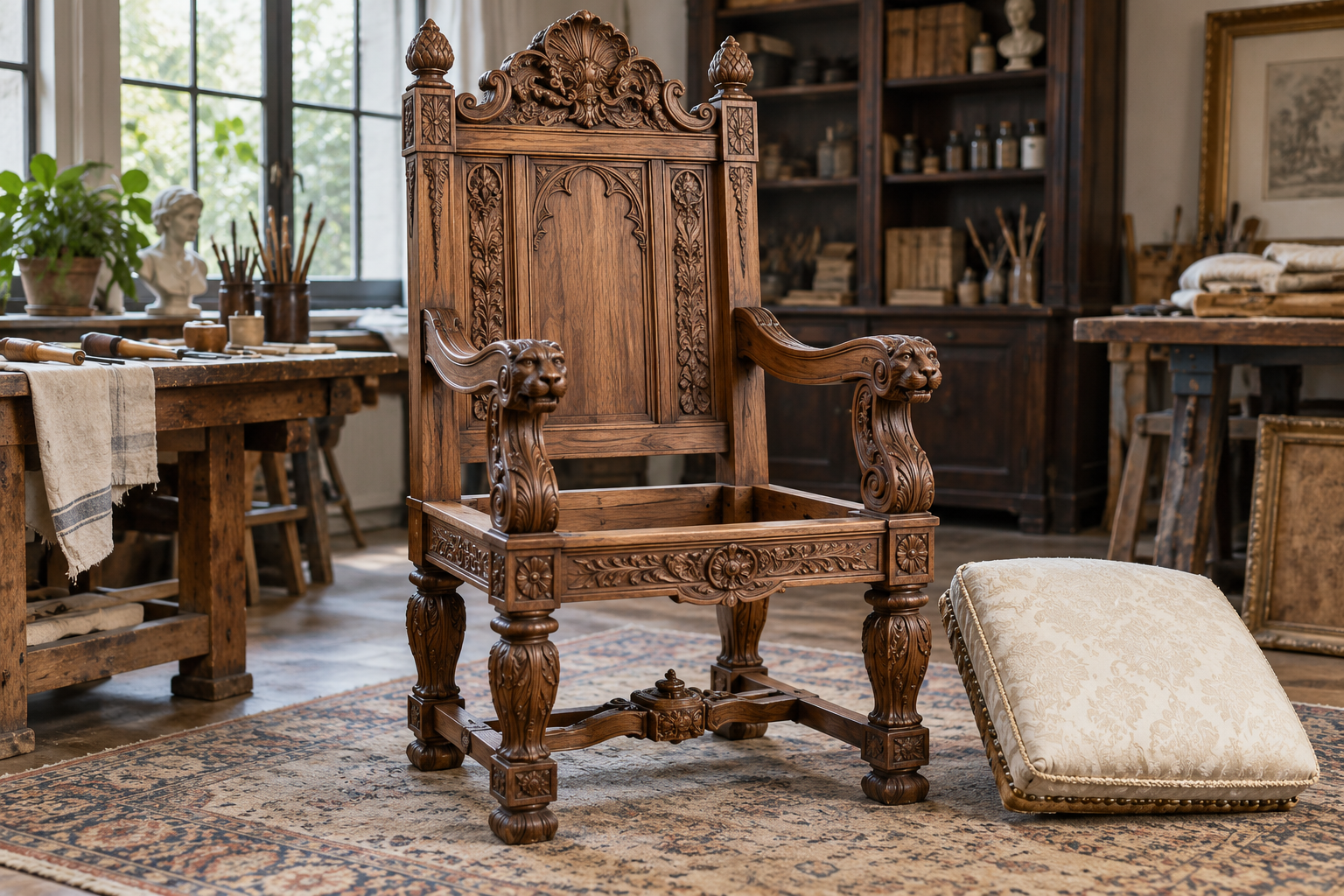
Look past the crown-shaped crest and a throne becomes a carefully arranged collection of parts. Legs and rails establish its frame, the seat supports its occupant, and the back and arms shape both posture and appearance. Upholstery, finials, carved panels, and applied emblems add another layer, sometimes concealing the connections beneath them. Seating Anatomy & Dimensions introduces the vocabulary that makes these relationships easier to see. Follow the chair from base to crest, distinguish attached ornament from structural members, and notice how cushions change the usable seating space. Explore the relationship between the throne itself and nearby elements such as a footrest, dais, or canopy. Clear identification helps when reading a museum description, discussing a commission, or comparing photographs of unfamiliar seating. It also prevents common assumptions: a substantial-looking carving may be decorative, and a smooth upholstered surface may hide several separate components. Learning the anatomy does not supply a construction plan, but it gives you a practical, precise, and accessible language for asking better questions and describing exactly what makes a particular throne distinctive.
Throne Foundations
- The seat is the occupant’s usable sitting surface; distinguish it from the wider decorative frame.
- The backrest supports or frames the area behind the occupant; its upholstery and frame may be separate assemblies.
- Armrests occupy the sides of the seat and influence both the silhouette and the route into the chair.
- Legs transfer the chair’s load to the floor; some designs conceal them behind a continuous decorative base.
- An apron is framing beneath the seat, while a decorative skirt may conceal that framing.
- Stretchers connect legs or frame members below the seat and are different from a separate footstool.
- A crest finishes the upper outline of the back; confirm whether it is integral or detachable.
- Finials terminate posts or other projecting elements; their appearance does not establish that they are suitable handles.
- Upholstery includes the covering and underlying support or padding, not just the visible fabric.
- Joinery and hardware connect components; a decorative seam can conceal a connection without explaining how it works.
Royal Facts
- Seat width describes the space available to sit; overall width also includes arms and projecting decoration.
- A tall crest can increase overall chair height without increasing the height of the occupant’s back support.
- An upholstered back may be finished differently on its front and rear faces.
- A plinth-style base can visually conceal the chair’s individual supports.
- Decorative panels can cover a frame without being the frame’s principal structural members.
- A removable seat cushion and a permanently upholstered seat require different access for replacement.
- Piping follows an upholstered edge; tufting creates fastened depressions within an upholstered surface.
- Exposed nailhead trim can be decorative; its presence alone does not describe the upholstery’s complete attachment system.
- A carved arm terminal is an ornamental end detail, distinct from the full arm support beneath it.
- The visible floor contact points may be glides, feet, or the underside of a continuous base.
Royal Picks
- For comparing chair specifications, request a labeled drawing showing the seat, back, arms, base, and crest.
- For a heavily carved design, request close photographs of corners and intersections where ornament can obscure construction.
- For upholstered seating, compare whether the seat pad is removable and whether the covering can be serviced separately.
- For a chair seen from all sides, evaluate rear panels and exposed fasteners as carefully as the front.
- For a detachable crest, request the connection detail and the dimensions of the chair with the crest removed.
- For decorative armrests, compare their inner clearance rather than their outside span.
- For carved feet, inspect how the actual floor-contact surfaces are finished and protected.
- For replacement trim, match the profile and attachment method before considering color alone.
- For a repair project, label removed components so matching left and right parts remain identifiable.
- For a commission, request an exploded drawing when transport or later servicing depends on separating assemblies.
Behind the Throne
- Trace the physical connection from seat to frame to floor when discussing a throne’s construction with its maker.
- Ask which visible elements are structural and which are applied ornament; similar finishes can hide that distinction.
- Examine where the arms meet the back and seat frame, rather than reviewing each component only in isolation.
- Compare the crest’s attachment access with the upholstery and rear panel that may conceal it.
- A decorative shell may need its own fixing points even when a separate frame carries the seated occupant.
- Map upholstery layers before ordering replacement parts; changing the covering may expose worn support beneath it.
- Record the orientation of asymmetrical carved components before disassembly.
- Check whether a removable cushion hides access to hardware, rather than assuming it is only a comfort feature.
- Keep a distinction between original components and later replacement parts when documenting an older chair.
- Treat decorative projections as vulnerable details during handling unless the maker identifies designated lifting points.
Throne Wonders
- The crest acts like a visual signature: a change at the top can transform the whole outline.
- Open spaces between the back’s frame members can contribute as much character as solid carved panels.
- A continuous base can make a chair appear monolithic even when its construction uses separate assemblies.
- Arms that flow into the backrest can create an unbroken silhouette around the seated figure.
- Contrasting piping can make the geometry of a cushion readable from across a room.
- The rear of a throne can carry its own composition when the chair stands away from a wall.
- Small repeated finials can connect the chair’s individual posts into a coherent decorative rhythm.
- A visible stretcher can become part of a design’s character instead of disappearing beneath the seat.
- A restrained frame can draw attention to the texture and shape of a single upholstered panel.
- Looking at a throne in silhouette is a useful way to separate its overall anatomy from surface ornament.
Throne FAQs
- Is the crest the same as the backrest? No. The crest is the upper finishing feature; the backrest is the larger assembly behind the occupant.
- What is beneath an upholstered seat? It may include padding, a support system, and a seat frame or panel. Ask the maker for the actual construction.
- Are armrests always separate parts? No. They may be distinct assemblies or integrated into the surrounding frame or shell.
- What is the difference between an apron and a stretcher? The apron frames the area beneath the seat; stretchers connect supports farther below it.
- Can a finial be used to lift the chair? Do not assume so. Use handling points identified by the maker.
- Does a solid-looking base mean solid construction? No. A continuous exterior can conceal a frame, panels, and separate supports.
- What is the difference between tufting and piping? Tufting creates fastened depressions in padding; piping defines edges with a covered cord or similar trim.
- Can the back of a throne be left unfinished? That depends on the specification, but a chair visible from behind should have its rear appearance agreed before purchase.
- How can I identify a detachable component? Request the assembly instructions or connection drawing; an ornamental seam is not reliable evidence.
- Which parts should I record before restoration? Photograph the whole chair and document individual components, connections, coverings, and any known replacements before work starts.
Designing Statement Seating: Form, Comfort, and Fit
A memorable seat needs more than a striking silhouette. Explore how form, usable dimensions, comfort, materials, and setting work together to turn an imaginative chair into a convincing physical design.