
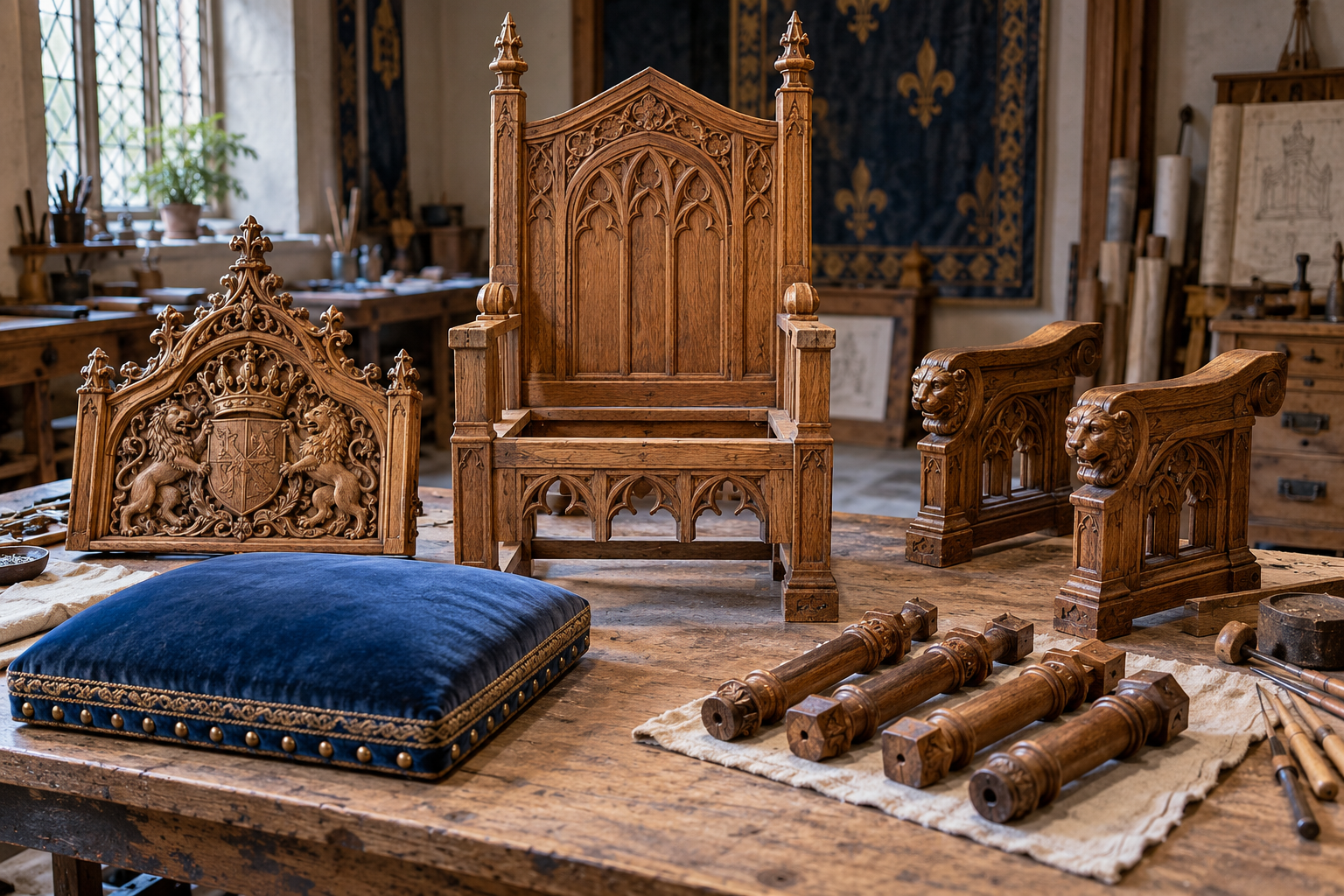
A close-up of a carved arm can be beautiful and still leave you unsure how it belongs to the throne. Seating Parts & Features connects that detail with its position, material, attachment, and role. Use this index to distinguish frame members, seat supports, upholstery, applied ornament, removable accessories, and elements of the surrounding installation. Front, side, rear, and underside views can reveal very different information, particularly when fabric or carving conceals connections. A feature's size does not establish that it is structural, and a restored component may match the original outline while differing beneath the surface. This section supports identification and comparison rather than supplying a fabrication plan. Record what is directly visible, what documentation confirms, and what remains inferred. Missing parts deserve the same care: surviving attachment evidence may establish that something existed without proving its appearance. By linking component names to specific examples and alternate forms, the index helps turn a general anatomy lesson into a more exact record, useful for research, visual analysis, maintenance discussions, and thoughtful interpretation of an individual throne.
Throne Foundations
- Locate the feature on the complete throne before studying a close-up.
- Separate structural frame, seating support, upholstery, applied ornament, and surrounding architecture.
- Record whether a component is integral, attached, removable, or missing.
- Use front, side, rear, and underside views where available.
- Distinguish a feature's visible shape from its hidden connection.
- Compare equivalent parts rather than unrelated decorative details.
- Note later replacements separately from surviving original components.
- Check whether a named feature appears on every throne type.
- Use measurements to describe proportions when visual impressions conflict.
- Treat this index as identification support, not a complete construction specification.
Royal Facts
- The seat platform and its cushion are separate components even when visually integrated.
- Arms can provide support while also carrying emblematic decoration.
- A high back can combine a frame, infill, upholstery, and applied crest.
- A stretcher occupies a different position and role from a seat rail.
- A footrest can be a separate object rather than an attached chair part.
- A skirt can conceal lower framing without replacing it.
- A removable medallion may be an applied ornament rather than a carved structural element.
- A throne's base can be visually continuous while containing separate joined pieces.
- A canopy may belong to the room installation rather than the portable chair.
- A visible peg or fastener can be functional, decorative, or both; context is needed.
Royal Picks
- Use a labeled elevation for locating major features.
- Create a component record with name, location, material, and attachment notes.
- Photograph rear connections when access and permission allow.
- Keep an alterations diagram beside the current feature map.
- Compare a plain-frame view with the finished upholstered view.
- Use detail images with an accompanying wider context photograph.
- Record missing parts without inventing their original form.
- Cross-reference material entries for ambiguous decorative surfaces.
- Keep measurements tied to identified reference points.
- Use different markings for confirmed observations and inferred connections.
Behind the Throne
- Applied carving can hide the boundary between two structural members.
- Upholstery can conceal evidence needed to identify the underlying support.
- A restored arm may match the outline while using different internal construction.
- A crest's symbolic importance does not establish whether it participates in supporting the back.
- A frontal image can make separate feet appear to belong to one solid pedestal.
- An attached accessory can later be mistaken for an original integral feature.
- A pierced back combines positive shapes and openings, both of which contribute to its identity.
- A component record becomes clearer when function, form, and decoration occupy separate description fields.
- A missing part may be known from attachment evidence even when its appearance remains uncertain.
- A thorough identification should preserve what cannot be established without examining concealed areas.
Throne Wonders
- Create an exploded visual index of a composite throne design.
- Compare arm forms across several documented seating types.
- Trace one crest from separate ornament to finished installation.
- Explore how removing upholstery changes the apparent back structure.
- Develop a parts map for a repaired ceremonial chair.
- Compare attached and independent footrest arrangements.
- Create a gallery of backs defined by open space.
- Study the relationship between feet, base, and surrounding dais.
- Build a reference sheet linking feature names to multiple viewpoints.
- Document a modern throne's component changes across successive revisions.
Throne FAQs
- Is every visible ornament structural? No. Identify its attachment and intended role rather than inferring function from size.
- How does this differ from a basic anatomy guide? This index supports detailed feature identification, component records, variants, and cross-references.
- Can a cushion be considered part of the seat? It belongs to the seating assembly, but distinguish it from the supporting platform.
- Is a canopy always attached? No. It may be independent architecture or part of a separate installation.
- How should replacement parts be recorded? Identify their location, material, date or attribution where known, and relationship to surviving components.
- What can a rear photograph reveal? Connections, labels, repair evidence, and construction details absent from the frontal view.
- Can hidden joinery be identified from style? Sometimes a hypothesis is possible, but concealed construction should not be reported as directly observed.
- How do I describe a missing feature? Record surviving evidence and relevant sources while distinguishing known details from reconstruction.
- Should measurements include decoration? Specify the reference points and distinguish overall envelope from functional dimensions.
- Can this index establish a safe repair? No. Identification aids discussion, while repair and structural decisions require appropriate examination and expertise.