
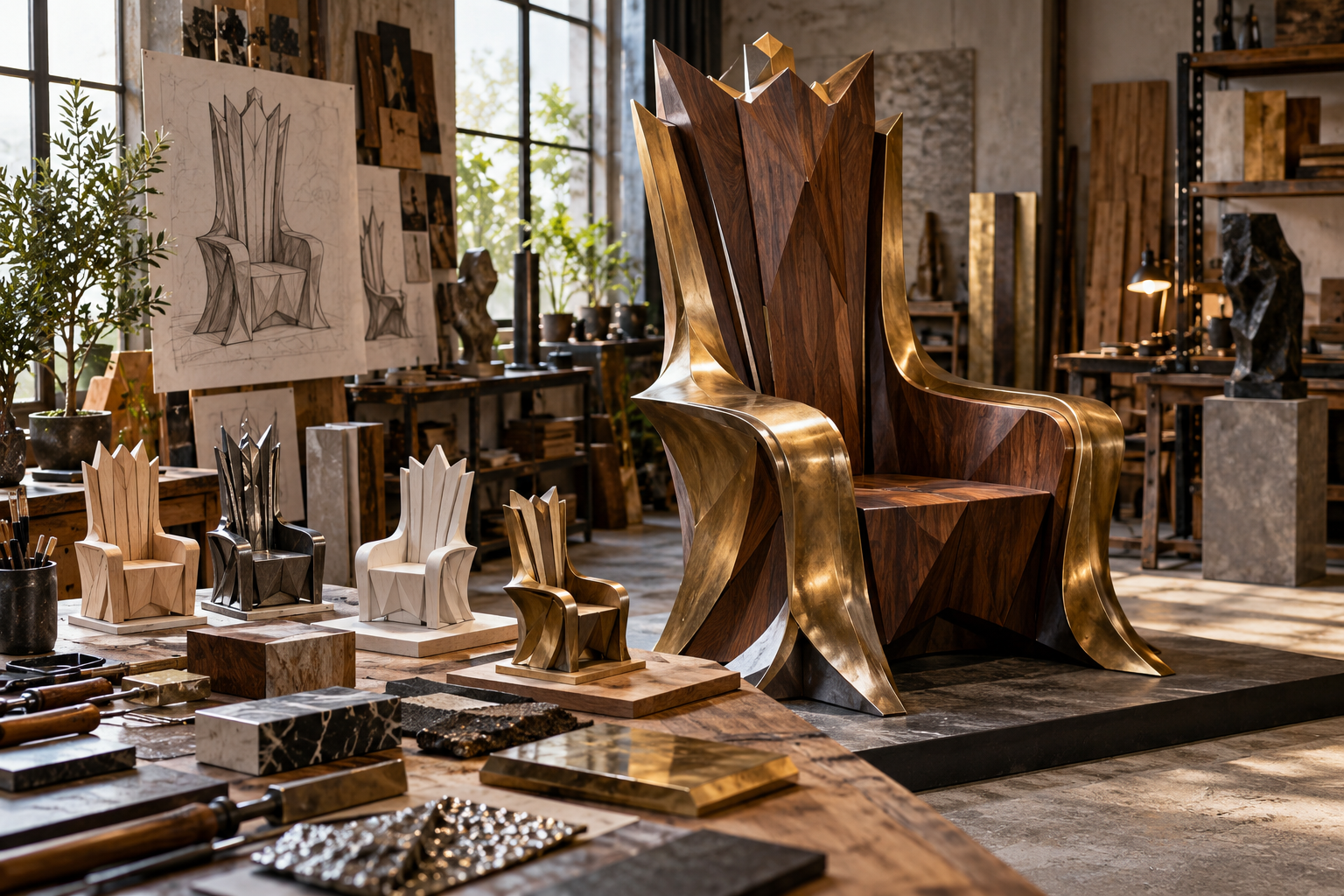
An original throne begins with a strong idea, not an inventory of impressive details. It might express a ruler's obligations, celebrate a maker's materials, embody a creature's protective posture, or reinterpret a familiar landscape. Concepts & Design Briefs follows the process of turning that central idea into a coherent design. Define the intended user and setting, develop several silhouettes, and test which features actually communicate the story. A memorable back, base, and seat should feel related rather than assembled from unrelated references. Explore the value of sketches, scale studies, material samples, and full-size mockups before refining ornament. This section also separates imaginative possibilities from the practical work needed to fabricate occupied furniture. The concept can be adventurous while its brief remains clear about use, access, transport, and maintenance. Consider how the design looks empty, occupied, from the side, and in its final environment. By refining one relationship at a time, you can create a throne with its own identity, giving makers a direction instead of asking them to combine every favorite image into one crowded object.
Throne Foundations
- Write a one-sentence concept describing who the throne is for and what makes it distinctive.
- Separate the design’s essential idea from decorative features that can change.
- Gather references for form, materials, setting, and mood instead of collecting chairs alone.
- Explore several silhouettes before developing one with detailed ornament.
- Use the intended occupant’s position to organize the seat, arms, and surrounding shape.
- Translate an abstract theme into visible choices such as proportion, texture, rhythm, and contrast.
- A concept drawing communicates an idea; it is not automatically a fabrication specification.
- A physical mockup answers questions that a polished rendering can conceal.
- Include practical constraints early so they can influence the concept constructively.
- Document why the selected direction fits the brief before beginning detailed development.
Royal Facts
- A reference board can contain several sources without requiring their features to appear together.
- A front elevation cannot establish the full depth of a proposed throne.
- A digital material appearance does not identify a purchasable material or coating.
- The same silhouette can support several different finish palettes.
- A concept can be original while using familiar furniture components.
- A full-size seat mockup and a small presentation model test different questions.
- An exploded drawing separates components that may appear continuous in a rendering.
- A chosen theme can be expressed through negative space rather than added ornament.
- An apparently simple form may require complex fabrication; appearance does not determine the process.
- A documented revision records both what changed and which design requirement prompted it.
Royal Picks
- Start with quick black-and-white silhouette alternatives before selecting color.
- Choose three reference images that explain different aspects of the brief.
- Use a simple scale model to test the idea within its setting.
- Request a full-size contact-area mockup when the seat or arms are unconventional.
- Compare two material routes for the same concept instead of changing the whole design at once.
- Create a detail sheet for the feature intended to become the throne’s signature.
- Use annotated drawings to distinguish fixed dimensions from exploratory proportions.
- Develop a plain version to test whether the idea survives without surface decoration.
- Ask a relevant maker to review fabrication possibilities before the concept becomes highly detailed.
- Keep rejected alternatives with short notes explaining why they were set aside.
Behind the Throne
- When references conflict, return to the brief rather than combining incompatible features by default.
- Check whether the main idea remains visible with an occupant sitting in the chair.
- Review the design’s side and rear identities before approving the front rendering.
- A narrative theme should lead to a few deliberate choices rather than a catalog of symbols.
- Mark scenic exaggerations that may need adjustment for physical seating.
- Resolve whether a dramatic crest separates for access before treating it as a seamless fixed element.
- Compare proposed textures at the scale they will appear on the finished piece.
- Record who approves the concept and which questions remain unresolved.
- Keep the original story idea distinguishable from later technical substitutions.
- At each revision, identify whether the change improves the central concept or merely adds complexity.
Throne Wonders
- A throne inspired by a musical rhythm could express repetition through its frame.
- A geological concept could layer smooth seat surfaces within fractured-looking outer forms.
- An abstract crown idea can shape negative space without placing a literal crown above the occupant.
- One distinctive joint can become the concept’s signature instead of an oversized crest.
- A family of related thrones can share one shape while varying scale and material.
- A concept developed from a landscape can focus on its horizon rather than recognizable plants.
- A reversible decorative panel can give a commission two intentional identities.
- An original fictional ruler can be characterized through restraint instead of extravagant ornament.
- A material limitation can prompt a clearer and more memorable silhouette.
- Removing a favorite detail can reveal which feature actually carries the design.
Throne FAQs
- Where should a custom concept begin? Define its occupant, use, setting, and distinguishing idea before selecting individual ornaments.
- How many references should I combine? Use only those that serve the brief; a larger collection does not require more features in the final chair.
- Should color come before form? Explore both, but test the silhouette independently so color does not hide unresolved proportions.
- Is a realistic render ready to manufacture? No. Materials, structure, dimensions, connections, and practical access still need development.
- Why keep several early alternatives? Comparing different solutions helps reveal which direction answers the brief most clearly.
- Can a familiar chair shape become an original concept? Yes. Originality can come from its proportions, material relationships, setting, and specific details.
- When should a maker join the process? Early enough to review feasibility before major visual decisions become difficult to revise.
- What belongs in a signature detail sheet? Show the defining feature’s shape, scale, materials, connections, and relationship to the whole chair.
- How do I evaluate a proposed revision? Compare it against the central brief and record which problem it resolves.
- How is this different from commissioning guidance? This category develops the design idea; commissioning guidance addresses specifying, approving, purchasing, and receiving the finished work.

Commissioning Custom Seating: Turn an Idea into a Clear Design Brief
A striking idea becomes a successful commission through clear decisions. Learn how to turn inspiration into a practical throne design brief, collaborate with a maker, review samples and drawings, and plan the finished chair’s arrival.