
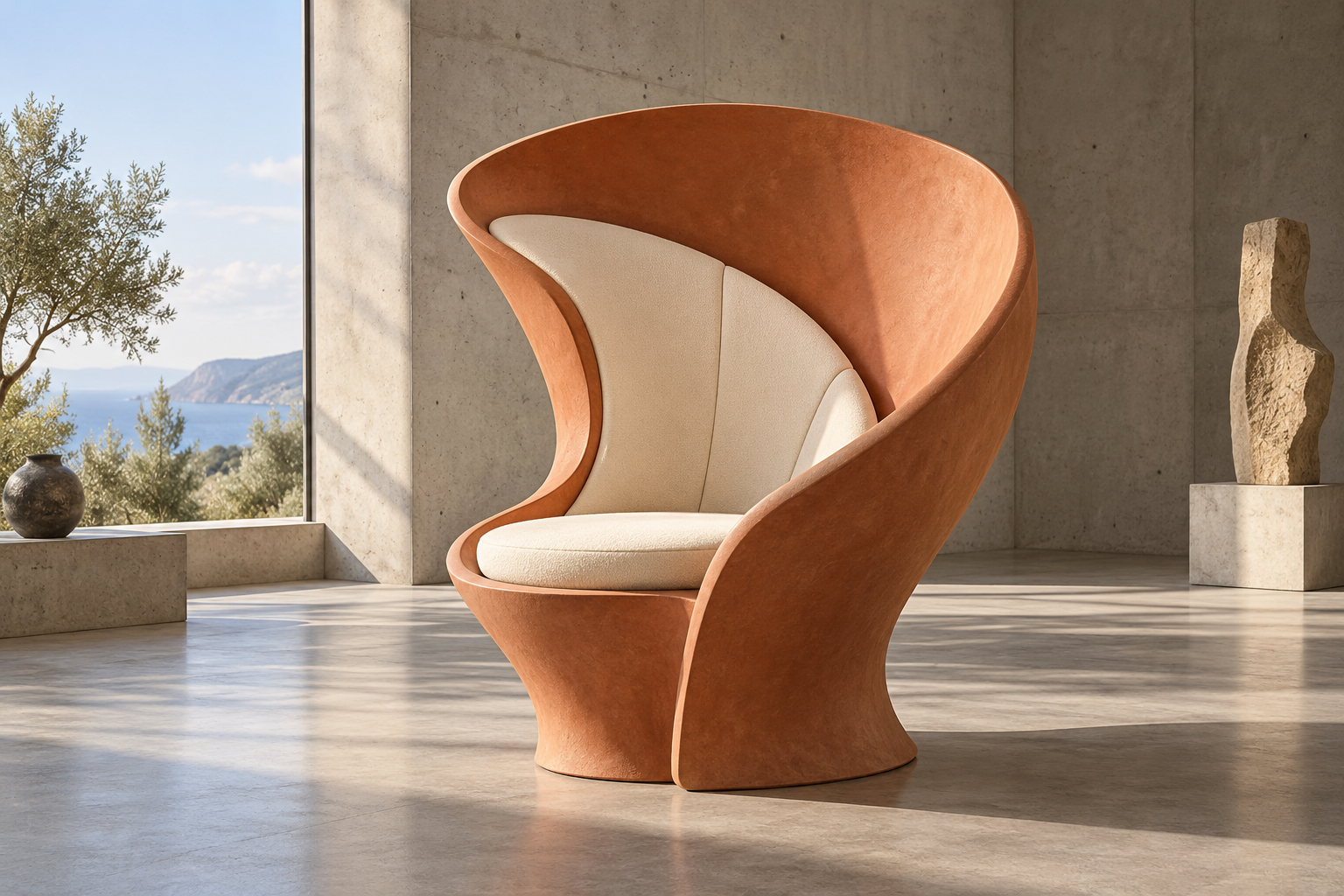
A throne does not need a crown-shaped back to command attention. A bold curve, an unexpected opening, or a carefully balanced mass can give contemporary seating a powerful identity. Modern & Architectural Seating explores designs in which overall form carries much of the expression. Start with the silhouette, then examine how the occupant fits within it and how the object changes as you walk around it. A seat that reads beautifully from the front may become heavy, awkward, or surprisingly open from the side. Compare continuous shells, assembled planes, geometric frames, and organic gestures without assuming that an unconventional shape is automatically comfortable or practical. Materials and finishes can reinforce the sculptural idea or compete with it. This section invites you to consider negative space, proportion, texture, and the relationship between furniture and room. It also distinguishes imaginative concept images from fabricated seating. For a home, exhibition, or fantasy setting, the strongest sculptural throne develops a clear idea thoroughly, allowing the form to feel intentional rather than depending on familiar royal decoration for its impact.
Throne Foundations
- Develop the chair’s major volumes before adding surface detail.
- A sculptural throne should be considered from the sides and rear, not only the front.
- Negative space is the open area between or around solid forms.
- A geometric concept can use planes, arcs, cylinders, or a deliberately limited combination.
- An organic concept can use flowing forms without imitating literal branches or animals.
- Distinguish a monolithic appearance from construction in one solid piece.
- Treat the occupant’s silhouette as part of the overall composition.
- Design the supporting structure alongside the exterior shell rather than assuming the shape supports itself.
- A restrained palette makes changes of proportion and texture especially noticeable.
- Resolve whether the result is occupied furniture, a display sculpture, or both before fabrication.
Royal Facts
- A seamless-looking shell can cover several joined components.
- An asymmetrical outline can surround a centered sitting area.
- A reflective surface changes appearance as the viewer moves.
- A matte surface and a glossy surface can share the same color while reading differently.
- A tall sculptural back can extend beyond the portion that supports the occupant.
- An open gap can be a defining visual feature rather than an unfinished detail.
- A render does not disclose the weight or internal construction of a proposed chair.
- A hidden base still occupies floor area and needs a specified connection to the shell.
- A continuous curve can cross the boundaries between separately fabricated parts.
- A chair’s rear face can become its principal view when placed centrally in a room.
Royal Picks
- Compare silhouette studies in solid black before selecting a material palette.
- Use a small physical model to examine the shape from changing viewpoints.
- Request a full-size seating mockup when the exterior form departs substantially from familiar chairs.
- Review a material sample with the proposed curvature and finish together.
- Compare reflected surroundings on a polished sample in the intended room.
- Choose a measured room model when a wide sculptural back affects circulation.
- Request a section drawing separating shell, support, upholstery, and fixing points.
- Test lighting from several directions before committing to dramatic surface geometry.
- Compare concealed and exposed joints as alternative design treatments.
- For a commission, agree which surfaces remain accessible for repair or replacement.
Behind the Throne
- Check the transition from an expressive back into the usable seat instead of reviewing those forms independently.
- Ask how a seemingly floating element connects to the load-bearing assembly.
- A strong front render can conceal awkward rear proportions; require additional views.
- A sculpted opening should not be mistaken for a handling point without the maker’s guidance.
- Review edges at the places where hands, forearms, and clothing contact the form.
- Distinguish an intentional shadow line from a manufacturing gap in the approved drawings.
- Identify the largest transport component before approving a seamless-looking installation.
- A polished shell may reflect nearby equipment or visitors that were absent from the concept rendering.
- Discuss how finish matching will work if one exterior panel needs replacement.
- Keep the approved object separate from any impossible or untested geometry used only in early concept art.
Throne Wonders
- A circular opening behind the occupant can become the throne’s visual signature.
- A low, wide throne can communicate presence without an oversized vertical crest.
- A single folded-plane idea can connect the seat, arms, and back visually.
- Contrasting an inner upholstered surface with an outer shell creates two distinct experiences.
- A sculptural throne can frame a view through its own negative space.
- A deliberately exposed joint can interrupt a smooth volume with a precise detail.
- One saturated color can emphasize the outline without additional carved ornament.
- A changing viewpoint can reveal a new silhouette within the same chair.
- An understated base can let the larger volume seem visually lighter.
- A room with simple surfaces can give an unconventional throne space to be understood.
Throne FAQs
- Does a modern throne need minimal ornament? No. The concept can be restrained or elaborate, provided its forms relate coherently.
- Is a seamless-looking throne one solid object? Not necessarily. Ask how the shell and structure are assembled.
- Can an asymmetrical throne remain usable seating? It can be designed that way; evaluate actual fit separately from its outer outline.
- What is negative space in a chair? The openings and unoccupied areas that help define its solid forms.
- Should I approve a sculptural throne from one rendering? No. Review multiple views, construction drawings, and a suitable mockup.
- Why test a reflective finish in the room? Its appearance includes the surroundings it reflects, not just its own color.
- Can a display sculpture double as seating? Only when its maker has specified it for occupied use.
- How do I compare two sculptural concepts? Review silhouette, usable sitting area, all-around views, materials, and installation requirements.
- Does hidden structure eliminate the need for drawings? No. Concealed supports and connections still need to be resolved.
- What should remain consistent from concept to fabrication? Identify the defining proportions, openings, finish, and seating function in the approved brief.