
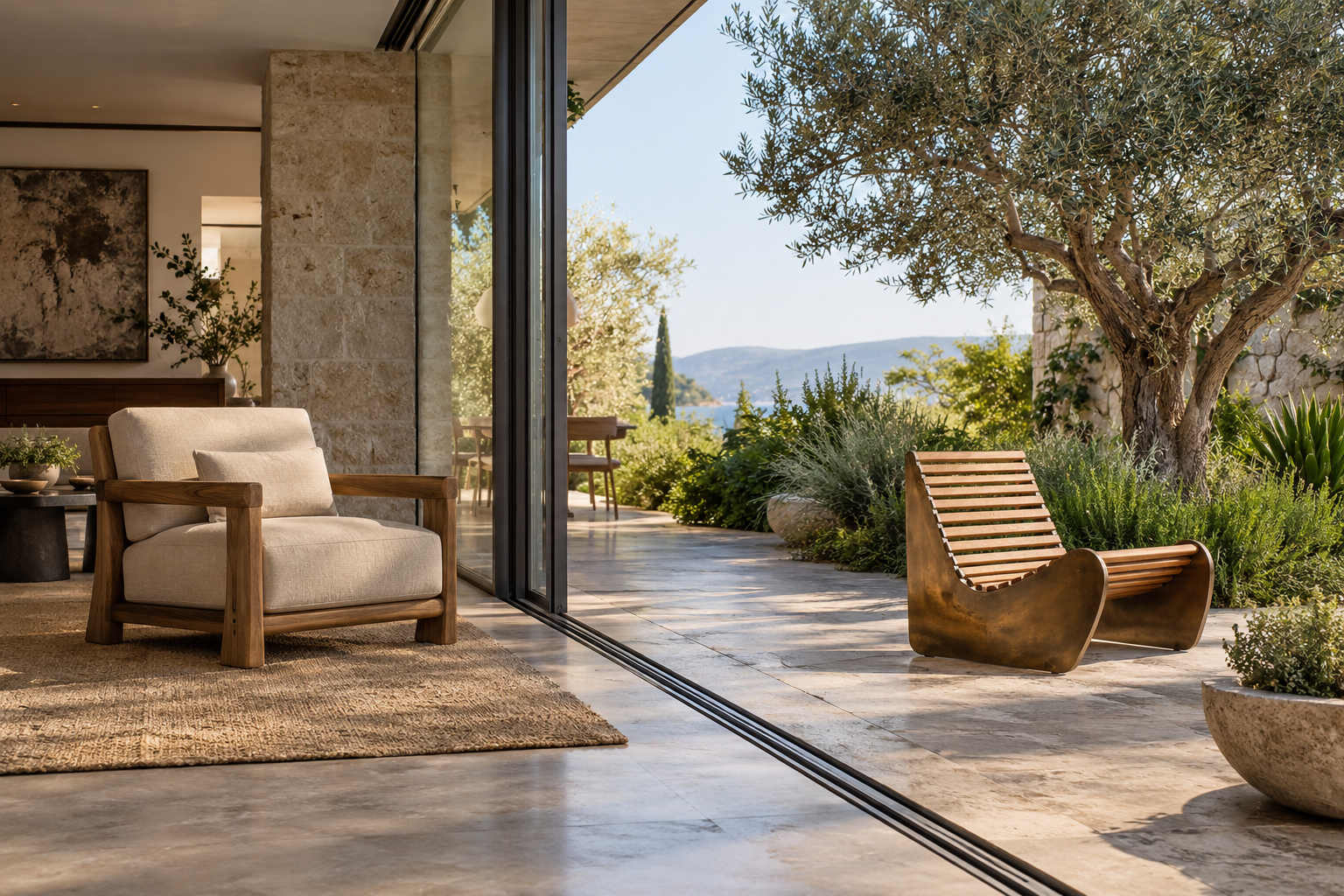
Moving a seating concept outdoors changes more than its backdrop. Light, moisture, temperature, wind, surrounding surfaces, and maintenance routines can alter the choices that made sense inside. Even the boundary between indoors and outdoors is not always simple: an open-sided pavilion, covered entrance, or sunny glazed atrium can create its own conditions. This section compares how statement seating responds to different environments. We look at materials, finishes, upholstery, details, placement, and visual scale through the actual setting rather than a broad label. A dramatic indoor silhouette may need a stronger relationship with planting or architecture outside. A surface that photographs beautifully under controlled lighting may behave differently in direct sun. Discover how to identify the conditions that matter, compare proposed assemblies, and ask useful questions about care and installation. The goal is to carry the design idea into its intended location thoughtfully. Whether the piece belongs in a lobby, garden, exhibition, courtyard, or destination plaza, its environment should be part of the concept from the beginning.
Throne Foundations
Describe the actual environment before choosing an indoor or outdoor approach. Direct rain, splash, sunlight, shade, humidity, cleaning, and temperature variation can affect different parts of the same installation. An interior atrium, covered terrace, and open garden are distinct settings.
Map those conditions onto the seat's surfaces and connections. Then compare complete assemblies, including upholstery, finish, support, and base. Moving a familiar indoor silhouette outside may require much more development than changing its topcoat.
Royal Facts
Shelter does not eliminate exposure. Moisture can reach a covered seat from the side, sunlight can be reflected, and sheltered recesses can collect debris.
Interior locations also differ: a frequently cleaned public display is not the same as a quiet private room. Color and sheen change under different lighting conditions, so the approved interior sample may look quite different outdoors. Record the real conditions and review relevant material documentation instead of relying on an unspecified claim that an item is suitable for any setting.
Royal Picks
Collect site photographs at relevant times of day, a record of likely exposure, and samples of the proposed finish and upholstery systems. Compare how recesses, seams, and ground-level details are resolved, not just the broad surfaces.
Include the care resources available at the site. For an adaptation, identify every existing component that remains and every component that changes. A meaningful comparison should show how each proposal handles the environment as an assembly rather than presenting two nearly identical images labeled indoor and outdoor.
Behind the Throne
Review places where conditions concentrate: the underside, upholstery edges, recessed ornament, panel junctions, and the connection to the ground. Ask how those areas are accessed for inspection and cleaning.
Consider how the object is installed and whether surrounding landscaping or irrigation changes its exposure. Material selection and detail design need to be coordinated with the relevant specialists. A visually sheltered part can still become troublesome if its shape traps moisture or prevents staff from seeing and reaching a developing problem.
Throne Wonders
Take the same palette into warm interior light, open shade, and direct daylight during sample review. A subtle metallic effect may become prominent outside; a dark recess may lose its modeled detail in an interior corner.
These differences can be used creatively. An outdoor chair might rely on a strong silhouette against changing surroundings, while an interior version can exploit controlled lighting and close material contrasts. Adapt the visual composition to the setting instead of expecting one presentation image to describe every experience.
Throne FAQs
Can an indoor chair simply receive an outdoor coating? A coating alone does not establish suitability for the whole assembly.
Is a covered installation equivalent to an indoor one? Describe its actual exposure first.
Should outdoor seating avoid upholstery entirely? Evaluate the specific system, intended use, care, and conditions rather than applying a universal rule.
What should remain consistent when comparing versions? The design purpose and usable geometry, while clearly documenting any changes to materials, detailing, installation, and maintenance needed for each environment.