
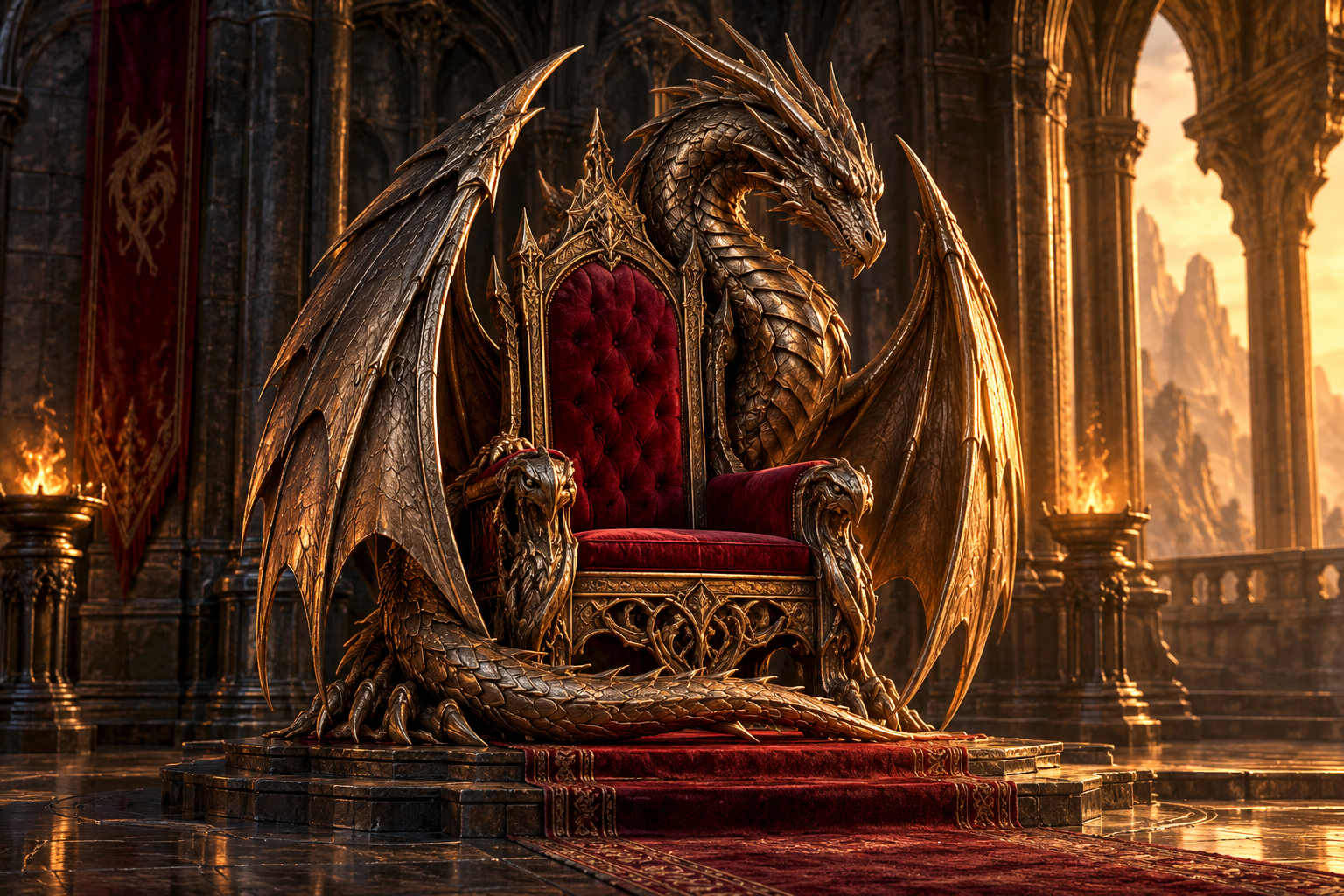
A dragon curling around a seat can seem protective, possessive, watchful, or ready to strike. The same creature motif changes meaning through posture and its relationship to the occupant. Fantasy & Creature-Inspired Seating explores that relationship as the foundation of fantasy seating. Begin by deciding whether the beast decorates the chair, guards the ruler, supplies an imagined material, or needs a throne designed for its own body. Wings, tails, antlers, claws, and folded limbs introduce different silhouettes and spatial needs. Compare a full sculptural creature with a few chosen anatomical references, and notice how texture supports the larger form. A coherent invented species communicates more clearly than a crowded collection of unrelated monster details. This section considers front, side, rear, and occupied views, with practical attention to contact areas when a concept becomes a physical prop. From gentle forest guardians to monumental scaled predators, the most convincing designs tell a clear story about the alliance or tension between ruler and creature. Ornament becomes memorable when it expresses that bond rather than simply surrounding the seat.
Throne Foundations
- Choose whether the creature is the throne's occupant, a carved emblem, a living companion, or the source of its imagined materials.
- Establish the creature's anatomy before designing a seat for it; wings, tails, claws, and extra limbs all change usable space.
- Develop one dominant beast gesture, such as encircling wings or a watchful head, to organize the throne's silhouette.
- Use the imagined creature's habitat to guide texture and palette, from mineral cave surfaces to weathered coastal forms.
- Distinguish a throne made for a dragon from a human throne decorated with dragons; they solve different design problems.
- Plan a calm seating zone within elaborate sculptural surroundings so decorative creatures do not overwhelm the occupant.
- Decide what the beast means within the fictional culture: protector, ancestor, rival, warning, or ally.
- Repeat selected anatomical motifs consistently rather than combining unrelated scales, feathers, horns, and fins without purpose.
- For a physical replica, separate visually sharp fantasy features from the surfaces people actually touch or pass.
- Write the relationship between ruler and creature before deciding whether the finished throne should feel cooperative or confrontational.
Royal Facts
- A creature motif can appear through outline and posture without requiring a fully sculpted animal on every surface.
- Bilateral symmetry produces a different impression from a single coiling beast that wraps unevenly around the seat.
- Large wings can frame the occupant while also obscuring the back of a physical display.
- A tail integrated into the base changes both the visual footprint and the route people take around the object.
- Recessed eyes suggest a different expression from protruding eyes, even when the rest of the creature's face remains unchanged.
- Dense scale texture can become visually noisy at distance; larger forms usually establish the first impression.
- An emblematic beast need not be depicted at natural size to communicate a fictional dynasty's identity.
- A human-sized chair with animal decoration does not automatically accommodate an occupant with nonhuman anatomy.
- Rendered fantasy bone, shell, and hide can be represented with fabricated finishes rather than actual animal materials.
- A design drawing's apparent balance does not establish the stability or load capacity of a finished chair.
Royal Picks
- Create a creature anatomy sheet showing where limbs fold and how the intended occupant approaches the seat.
- Use a plain silhouette study to compare coiled, perched, crouching, and wing-framed arrangements before adding texture.
- Prepare a sculpted texture sample at intended viewing distance to judge whether scales read clearly or disappear.
- Choose a small set of motif references from one invented species to keep its horns, claws, and armor visually coherent.
- Mock up wing spans with inexpensive stand-ins before committing to a full-size event or display installation.
- Request both occupied and empty concept views; a dramatic empty throne can hide the person seated in it.
- Use detachable decorative elements where transport and venue access make a broad creature silhouette impractical.
- Compare warm and cool lighting on the beast's face to check whether its intended expression survives different settings.
- Keep material swatches for body surfaces, eyes, claws, and seating upholstery together when approving the final palette.
- Select display photographs that show side and rear views, especially when a creature wraps around the whole throne.
Behind the Throne
- A beast positioned behind the ruler may seem protective, possessive, or threatening depending on its gaze and distance.
- Placing a creature beneath the seat can imply support or subjugation; make that relationship an intentional storytelling choice.
- A dragon throne can show age through repaired scales, shortened horns, or mismatched additions instead of simply covering everything in distressing.
- Creature features need hierarchy: the head may carry identity while wings establish scale and the base anchors the composition.
- A seat built from a fictional creature's remains invites questions about how it died and why its body became a royal object.
- Matching a throne to a living companion creates opportunities for visual echoes without physically incorporating the animal into the furniture.
- A looming jaw above the occupant can create a dramatic frame but may dominate portraits taken from a low angle.
- The back view can tell a second story, revealing folded wings, resting claws, or a creature's apparently relaxed posture.
- Repeated tiny teeth can distract from a facial expression; simplifying secondary detail may make the beast more convincing.
- A fictional alliance becomes legible when ruler and creature share symbols while retaining distinct visual identities.
Throne Wonders
- Imagine a dragon council throne shaped around folded wings, with a human ambassador's seat built into a neighboring ledge.
- Design a guardian lion whose carved mane becomes the throne's back while its gaze turns toward approaching visitors.
- Create a sea-beast seat with layered shell forms and a tail that visually traces the edge of a tidal dais.
- Explore a phoenix throne whose removable feather panels change color across successive fictional reigns.
- Picture an antlered forest guardian framing the ruler with branching negative space instead of a solid high back.
- Invent a throne commissioned to reconcile two rival houses, combining their beasts in a cooperative rather than combative pose.
- Develop a sleeping dragon design that seems peaceful from the front but reveals one open eye from the side.
- Build a concept around a tiny royal creature, making an oversized human court gather around its miniature ceremonial perch.
- Imagine a stone beast whose missing features have been repaired in contrasting metal by generations of royal makers.
- Design a throne for a feathered serpent whose long body determines a spiral audience chamber rather than a conventional rectangular hall.
Throne FAQs
- Should my dragon throne include a full dragon sculpture? Only if it serves the composition; a distinctive head, wing shape, or tail can communicate the idea.
- How do I keep the occupant visible? Check seated mockups from expected camera angles and reduce features that cross the face or shoulders.
- Can a beast throne look welcoming? Yes. Relaxed posture, open framing, softer expressions, and a comfortable central seat can support a protective mood.
- How should I design for a winged character? Establish its folded-wing posture and movement needs first, then shape the back and surrounding clearance accordingly.
- Must the creature be symmetrical? No. Coiling or resting poses can be asymmetrical while remaining visually coherent.
- Can I combine several animals in one design? Yes, but define a consistent hybrid anatomy and narrative purpose rather than adding unrelated features everywhere.
- How can I suggest enormous scale in a small throne? Use oversized individual details, partial creature forms, and a silhouette that implies a body extending beyond the seat.
- What makes fantasy scales look convincing? Consistent direction, variation linked to body areas, and clear underlying anatomy usually matter more than sheer texture density.
- Are realistic horns suitable near users? A physical throne needs contact-safe detailing and an appropriate construction review; visual realism alone is not the approval criterion.
- How can I make a familiar dragon motif original? Develop its species, relationship to the ruler, habitat, posture, and cultural symbolism as a connected design.
Dragon Throne Ideas: From Dramatic Wings to Carved Scales
Dragon wings, scales, claws, and curling tails offer far more than decoration. Discover how to turn those forms into a clear, balanced throne concept with a readable silhouette and an identity of its own.
Fantasy Throne Design: From Story Concept to Physical Seating
Bring a fantasy seating concept into the physical world. Follow the design from a clear story idea through silhouette, materials, occupant space, scenic surfaces, and a practical brief for fabrication.