
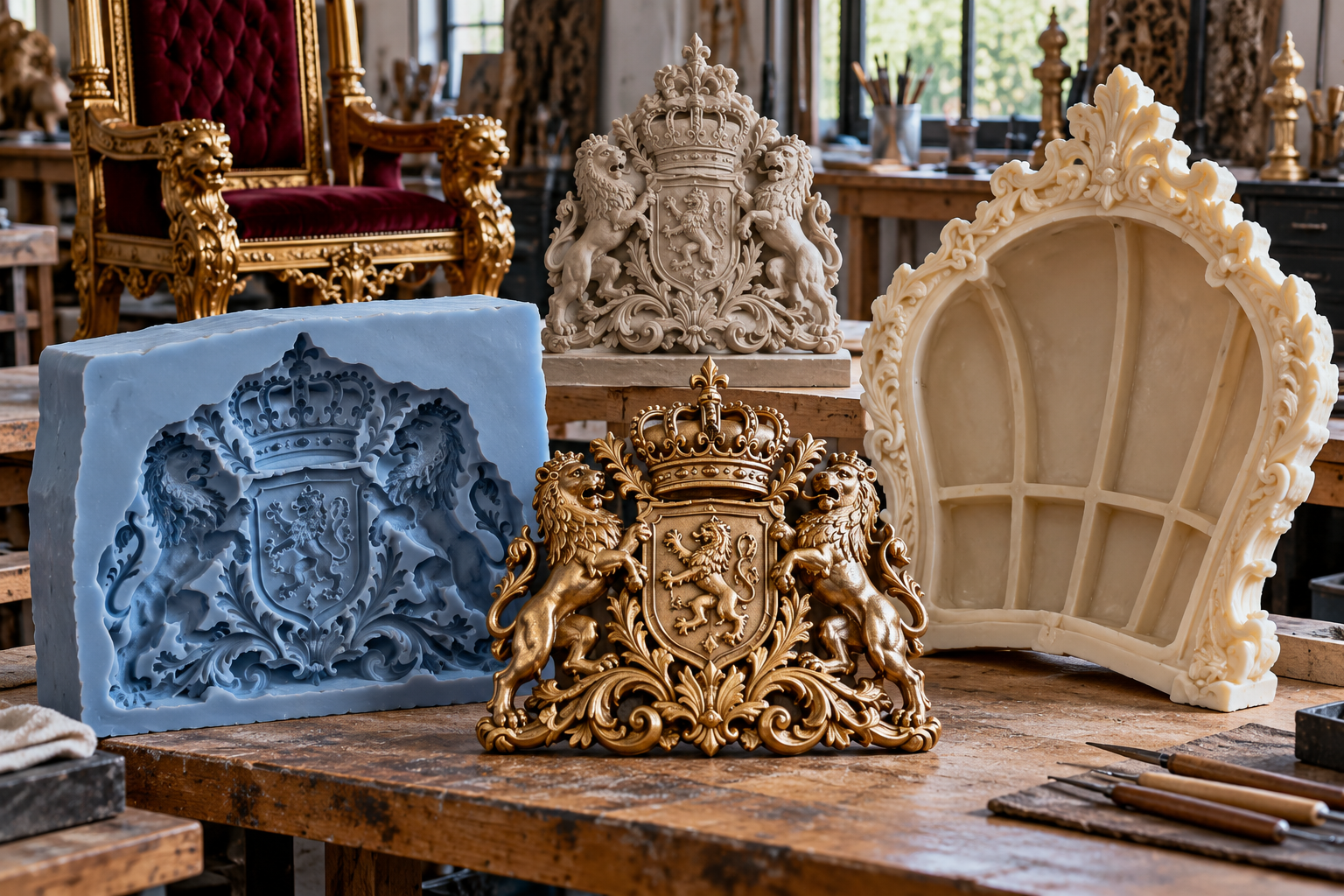
Repeated crests, sculpted creatures, elaborate borders, and translucent-looking accents can all begin with a carefully prepared master and a planned mold. Resin, Fiberglass & Composite Skins examines the choices behind those parts. Distinguish the master, mold, casting material, reinforcement, and finish rather than describing the whole process simply as resin work. Geometry affects parting lines, undercuts, removal, seams, and attachment, while the exact product determines its processing requirements. Working time, demolding, and later cure stages are different considerations; a general material name cannot replace the manufacturer's current instructions. This section also separates decorative castings from components assigned a structural role. Explore how test pieces, labeled batches, interface samples, and documented additions make results easier to assess and reproduce. A final ornament may conceal substantial preparation, but the master carries its imperfections into every copy unless they are resolved first. Whether commissioning a composite shell or developing replaceable fantasy details, begin with a clear part specification. That foundation makes the imaginative surface easier to achieve while preserving the records needed for troubleshooting, finishing, repair, and future production.
Throne Foundations
- Decide whether the part is a decorative casting, a surface shell, or a designed structural component before choosing a material system.
- Read the exact resin's technical bulletin and safety data before planning molds, tools, or the work area.
- Separate the master pattern, mold material, casting material, and finishing system in the project specification.
- Design the mold's parting line around the form's undercuts and intended removal sequence.
- Choose a casting approach compatible with the part's geometry, thickness, and the manufacturer's application limits.
- Plan attachment inserts and mating surfaces before producing the finished decorative parts.
- Record whether the specified mixing ratio is by weight or volume; these instructions are not automatically interchangeable.
- Distinguish available working time from demolding time and any later cure or post-cure requirements.
- Test mold release, resin, pigment, and finish compatibility on a representative sample.
- Keep batch records so a failed casting can be investigated rather than repeated through guesswork.
Royal Facts
- Resin is a broad material description; polyurethane, epoxy, and polyester systems can have very different processing requirements.
- A composite combines materials, such as a resin matrix and reinforcement, rather than describing every solid resin casting.
- Pot life describes a product's working interval under stated conditions, not a universal period applicable to every batch.
- Smooth-On's specification charts list viscosity, mixing ratio, pot life, cure time, and hardness as separate properties.
- A hard cured surface does not establish the strength or suitability of the complete part and its connections.
- An undercut can prevent removal from a rigid mold unless the mold design provides an appropriate solution.
- A casting can reproduce unwanted scratches and seams from the master along with its intended ornament.
- Clear resin and opaque resin create different appearance requirements for bubbles, inclusions, and internal surfaces.
- Demolding readiness and readiness for final service can be different stages in a product's instructions.
- A hollow decorative shell and a solid casting may look similar externally while having different weight and construction details.
Royal Picks
- Use the manufacturer's technical bulletin as the starting checklist for comparing candidate casting systems.
- Make one representative ornament before committing to a mold intended for repeated production.
- Prepare a mold drawing that identifies parting lines, registration features, fill access, and removal sequence.
- Keep measuring equipment appropriate to the specified ratio method and expected batch size.
- Label test castings with material, batch, pigment, conditions, and cure schedule rather than judging unlabeled samples later.
- Request documented reinforcement and connection details when commissioning a composite component intended to support loads.
- Use a finish sample made on the actual cured material to assess adhesion and appearance.
- Plan a supported storage position for molds so they retain their intended shape between casting sessions.
- Select replacement ornament designs that can be reproduced without dismantling the entire throne.
- Keep manufacturer-approved handling and workspace requirements alongside the project materials instead of relying on remembered generic advice.
Behind the Throne
- A visually complex master may need multiple mold sections, increasing alignment work and the number of seams to finish.
- A repeated crest can be economical to cast, but the first master and mold still require substantial preparation.
- Pigment or filler changes should be checked against the resin's instructions rather than treated as purely decorative additions.
- Large or thick forms need product-specific processing review; multiplying a small successful batch is not an automatic scale-up method.
- Attachment hardware can concentrate forces in a decorative shell unless its interface is deliberately designed.
- A master finished too roughly can transfer imperfections to every copy, making early cleanup especially valuable.
- A glossy metallic-looking finish can draw attention to mold seams that a textured scenic finish disguises.
- A mold designed for easy release may require a different seam location from the one that looks best in the final display.
- A damaged casting provides useful evidence when its batch record preserves the exact material and processing conditions.
- A commission should distinguish decorative resin ornament from any engineered composite frame so neither role is inferred from appearance.
Throne Wonders
- Create a family of interchangeable royal emblems from separate masters that share one documented mounting interface.
- Explore translucent decorative jewels whose colors coordinate with upholstery without pretending they are natural gemstones.
- Design a cutaway sample showing the difference between a solid cast ornament and a reinforced shell.
- Develop a mold library that preserves replacement details for a throne used across many event seasons.
- Compare painted stone, metal, and ceramic effects on identical cast shapes to isolate the finish's contribution.
- Imagine a fictional dynasty adding a new cast medallion to the throne after each reign.
- Create paired master samples showing how deliberate surface texture survives molding and finishing.
- Design modular corner ornaments that can be replaced individually after transport damage.
- Build a fabrication display that presents the master, mold, raw casting, and finished ornament together.
- Explore a visually layered crest assembled from separately cast pieces rather than one difficult-to-release form.
Throne FAQs
- Which resin is best for throne ornament? Compare the exact part, process, finish, exposure, and manufacturer's specifications; the general resin family alone is insufficient.
- Can I substitute a weight ratio for a volume ratio? Only if the manufacturer provides the corresponding ratio; equal-looking numbers are not automatically equivalent.
- Does cure time mean the part is ready for use? Check the product instructions for demolding, full cure, post-cure, and service requirements separately.
- Can I make a full throne from a decorative casting resin? Do not infer occupant-supporting suitability from small ornament applications; the complete design needs appropriate material and structural review.
- Why does every casting show the same scratch? Molds reproduce the master's surface, so inspect and finish the master before making production tooling.
- Can pigments be added without affecting the process? Use compatible additions within the exact manufacturer's guidance rather than assuming all colorants behave alike.
- How should an undercut be handled? Resolve it in the mold design through an appropriate material, parting arrangement, or revised master before casting.
- Is a hollow part always less durable than a solid one? Not necessarily; material, geometry, reinforcement, and use determine performance, not appearance or hollowness alone.
- What should I record after a failed casting? Preserve the product and batch, ratio method, additions, conditions, timing, mold preparation, and observed defect.
- Should I buy pressure or vacuum equipment first? Determine whether the chosen material and process require it, then follow the equipment and material manufacturers' instructions.