
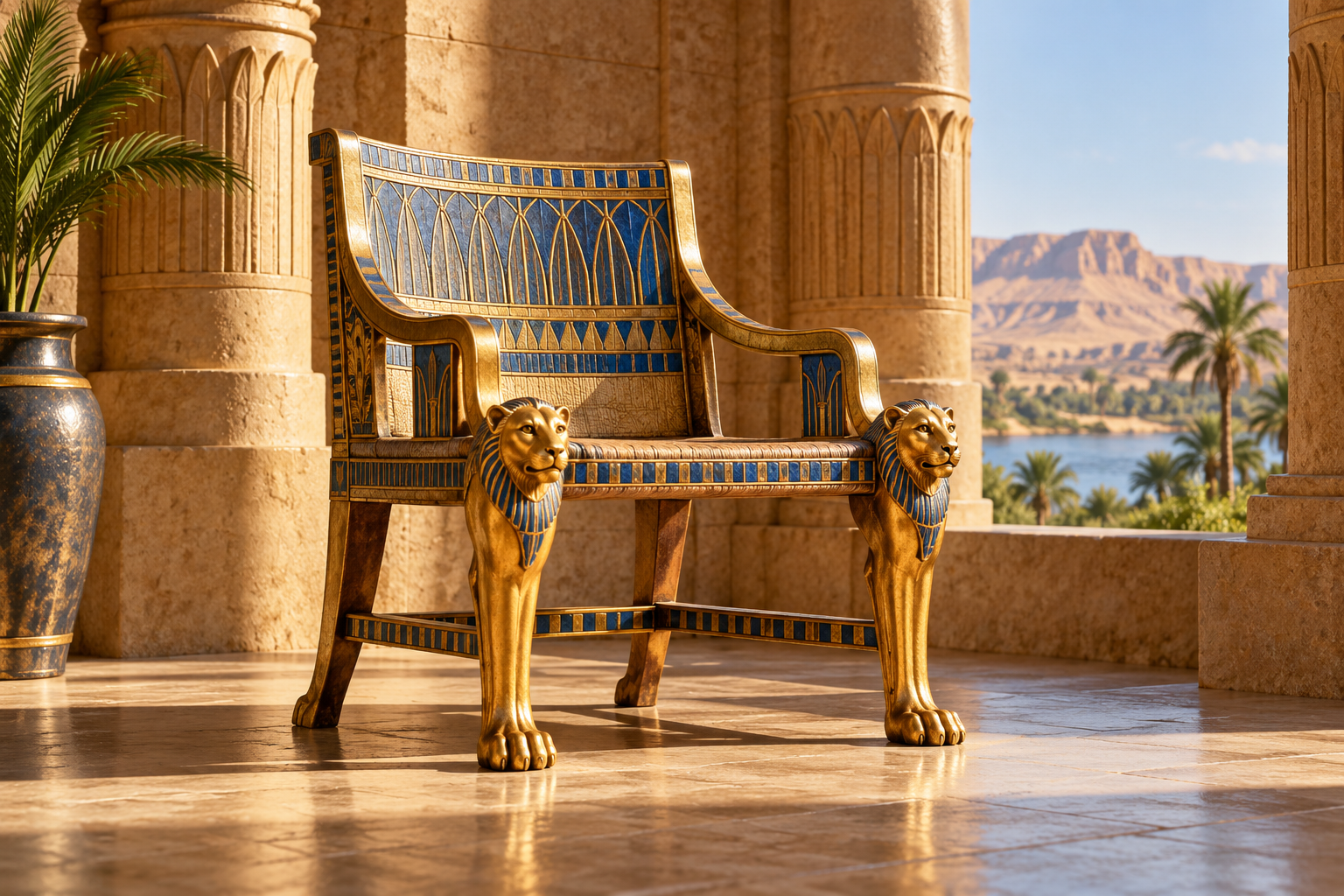
Ancient seating offers a close view of how craftsmanship and authority were made visible. Surviving chairs, fragments, images, and written records provide different kinds of evidence, and each needs careful interpretation. Ancient Seats of Power brings those sources into a design-focused conversation. Explore proportions, supports, animal forms, inlay, surface treatments, and the relationship between a seat and its ceremonial setting. An Egyptian artifact, a Greek depiction, and a Roman representation should not be treated as interchangeable illustrations of one ancient style. Their materials, contexts, and surviving evidence differ. Modern reconstructions can help people imagine a complete object, but they also introduce choices that must remain distinguishable from what is known. This section encourages attention to the specific documented example before drawing broader conclusions. A painted scene may communicate status without functioning as a measured furniture drawing, while a repaired object may contain several periods of material. By connecting visual observation with reliable records, ancient seating becomes a source of thoughtful design insight. The result is inspiration grounded in the physical details and uncertainties of the evidence rather than familiar symbols repeated without explanation.
Throne Foundations
Start by identifying what survives: a complete seat, a fragment, a depiction, or a written description. These sources answer different questions.
A painted chair may show an intended silhouette, while a surviving joint can reveal how actual parts met. Record the object's location, attributed period, and source of that attribution before interpreting its appearance. Keep observations separate from reconstruction: an absent cushion, missing leg, or uncertain surface color should remain an open question rather than becoming an invented detail.
Royal Facts
A museum's object date, excavation date, and acquisition date describe different events. Read those labels carefully when building a timeline.
Materials also need precise identification: a gilded surface does not establish a solid gold structure, and a stone depiction does not prove that the furniture it represents was stone. Photographs can distort proportions through viewpoint. Use recorded dimensions when available, and identify whether those measurements describe the surviving fragment or a proposed complete object.
Royal Picks
Build a small reference set around one object instead of collecting unrelated images. Look for an institution's catalog entry, views of the reverse and underside, and an explanation of any restoration.
A measured drawing can complement a photograph by clarifying outlines obscured by shadow. For a design study, keep separate sheets for documented features and imaginative interpretations. This makes a carved foot, patterned panel, or back profile useful as inspiration without implying that the new chair is an archaeological replica.
Behind the Throne
The most revealing details are often at transitions: where a leg meets a rail, an inlay ends, or a covering turns around an edge. Ask what evidence supports the proposed assembly and which elements were replaced during conservation.
Distinguish a surface's present appearance from claims about its original finish. When translating an ancient form into a modern prop, develop a new supporting structure and occupant layout; visual resemblance alone does not establish how a usable seat should be built.
Throne Wonders
Try comparing the same seat in three ways: as a silhouette, as a collection of surface details, and as an object within its depicted setting. Each view can suggest a different source of presence.
A modest chair may appear commanding because of surrounding figures or an elevated position. Conversely, a fragment can preserve an elaborate detail that disappears in a distant view. These shifts make ancient seating an absorbing design subject without requiring every example to be presented as a monumental throne.
Throne FAQs
Can a depiction provide exact dimensions? Usually not without additional evidence; record what the source actually establishes before making a scale drawing.
Does an old-looking reproduction count as an ancient seat? No: identify reproductions and reconstructed portions explicitly.
How should uncertain details appear in a concept? Label them as interpretive choices, and explain which documented feature inspired them. For a contemporary occupied version, resolve fit and construction independently rather than treating the historical image as a ready-made fabrication plan.