
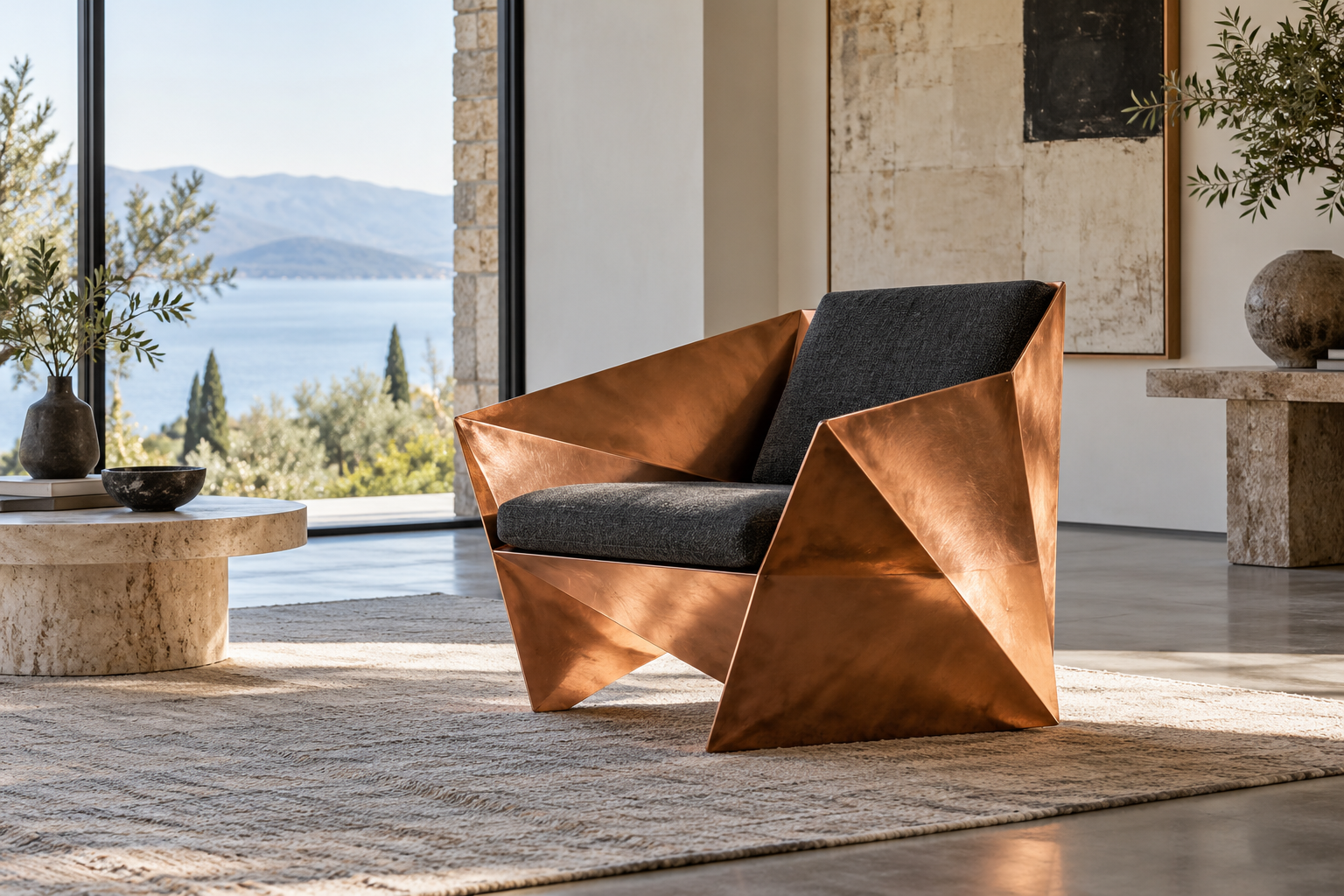
The most interesting designer seating often begins with a clear question about form, material, or the way people occupy space. A folded sheet becomes a shell, a repeated timber element becomes a curve, or an upholstered volume becomes an architectural gesture. This section explores that inventive territory between furniture and sculpture. We look at how a concept develops, how craftsmanship makes it convincing, and how the finished piece relates to its surroundings. The aim is to understand design decisions rather than rank products or celebrate a name without examining the work. Proportion, edges, connections, surface transitions, and views from different directions all help explain why a chair feels resolved. Some projects are unique commissions; others develop through editions or production methods. Those contexts influence what can be changed and how the object is made. Explore original seating concepts, material-led experiments, and thoughtful approaches to visual presence. By looking beyond the first striking photograph, it becomes possible to appreciate both the imagination of a piece and the careful physical decisions that support it.
Throne Foundations
Read designer seating as a developed idea rather than a decorative category. Identify the central proposition: a material used expressively, a continuous line, an unusual relationship between support and shell, or a sculptural response to the body.
Then examine how the rest of the object follows that proposition. A prototype, a one-off commission, and a production edition face different constraints. State which kind of work is being discussed before comparing the design's construction, finish, or repeatability with another piece.
Royal Facts
A presentation image can hide the details that distinguish a resolved design from an attractive concept. The underside, material junctions, and rear elevation often reveal how the object is assembled.
A polished prototype also does not establish that every later example is identical. When discussing a specific piece, distinguish the designer's stated intention from your visual interpretation. Materials and processes should be identified from documentation where available rather than inferred solely from the color or texture of a photograph.
Royal Picks
Useful references include process sketches, models, maker explanations, and close views of transitions. Select examples that help answer one question at a time: how a shell meets a base, how upholstery terminates, or how a chair works when viewed from behind.
For a new sculptural concept, pair those studies with your own model and a human-scale seat outline. The aim is to understand the design work between the first gesture and the completed object, not simply collect impressive finished forms.
Behind the Throne
Follow a difficult detail through the whole assembly. Where does a soft surface meet a hard edge? How is an apparently continuous curve divided for fabrication?
Can a fastener be reached after the surrounding panel is fitted? These questions do not diminish the sculptural idea; they explain how it survives contact with physical making. A successful transition often looks inevitable because considerable work has made it appear simple. Documenting that process gives the finished chair a richer and more credible design story.
Throne Wonders
Walk around a model and observe when its character changes. A broad frontal composition may become a thin line from the side, while an opening may appear only from behind.
Sculptural furniture can use these changes deliberately, particularly when placed away from walls. Another useful study is to compare the occupied and empty forms. The person may complete a curve, interrupt a void, or change the apparent balance, making the seat an experience rather than a static object to admire.
Throne FAQs
Is sculptural furniture always a one-off? No; the category can include individually made work and repeatable designs.
Does a striking shell have to define the contact surfaces? Not necessarily; the occupied area can use different geometry and materials.
Can a rendering establish that a chair is ready for fabrication? It does not resolve hidden assembly or fit on its own.
What should a design discussion emphasize? The central idea, its physical development, and the particular evidence available for the object being described.