
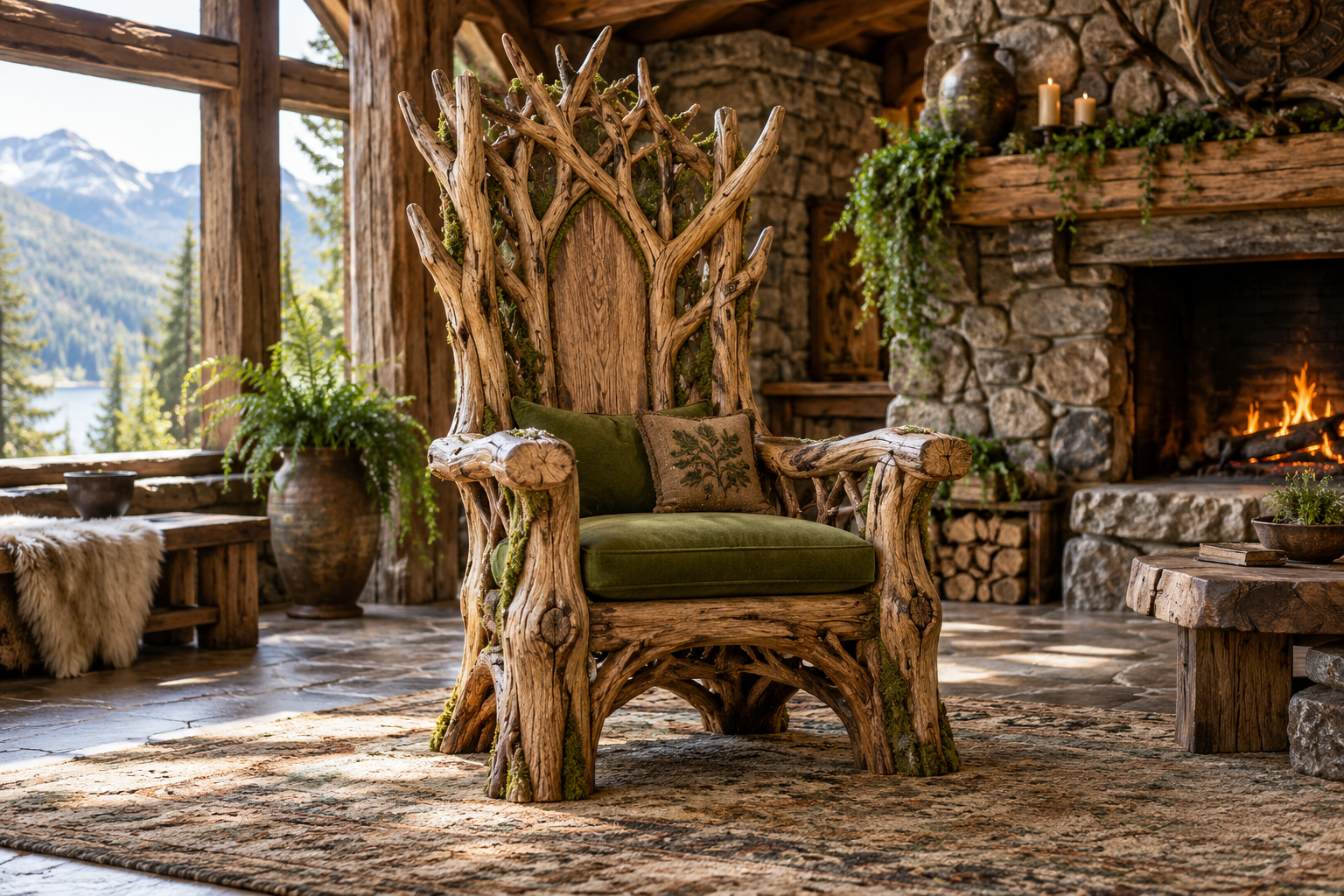
A branch-like arm, a broad timber surface, or the rhythm of repeated leaf forms can connect a throne to the natural world without making every inch look like a forest. Rustic & Organic Seating explores that range, from visibly worked wood to stylized botanical silhouettes. Begin with the particular quality you most want to express visually: ruggedness, shelter, age, growth, or quiet simplicity. Then consider how grain, texture, color, and negative space support it. A natural-looking material is not automatically suitable for outdoor use, and a rough appearance should not be confused with unfinished contact surfaces. This section keeps visual inspiration and practical specification in conversation. Compare recognizable branches and roots with more abstract interpretations, and notice how one consistent growth pattern can unify a complicated design. The surrounding setting matters too: the same seat can feel earthy in a garden, theatrical on a stage, or restrained against a simple interior wall. Discover how carefully chosen specific natural references can create character while preserving a clear, comfortable center for the person who occupies the throne.
Throne Foundations
- Choose a specific natural reference: woodland growth, exposed rock, river forms, or cultivated garden structure.
- Rustic appearance and actual outdoor suitability are separate design questions.
- A natural edge follows an irregular outline; identify whether it is retained, carved, or simulated.
- Visible grain can provide ornament without adding a carved pattern.
- Branch-like forms may be structural members or applied scenic details; specify their role.
- A nature-inspired throne can be carefully finished rather than deliberately rough.
- Coordinate the seat’s usable surfaces with more expressive surrounding ornament.
- Let the chosen landscape inform proportions and textures instead of combining unrelated natural motifs.
- A stone effect is a surface interpretation unless actual stone construction is specified.
- Use botanical or animal references as original design inspiration without making unsupported claims about historic symbolism.
Royal Facts
- A bark-like surface can be carved or coated over a different substrate.
- An irregular exterior can surround a regularly shaped seat opening.
- Wood species and finish both affect the appearance of a visible grain pattern.
- A weathered effect can be newly applied rather than evidence of age.
- Artificial foliage and carved foliage require different attachment and care arrangements.
- A rough-looking back may have a smoother contact surface on its occupant-facing side.
- A branch silhouette does not prove that unmodified branches were used in construction.
- A garden setting can expose hidden materials as well as the visible exterior to weather.
- Natural variation makes an approved material sample a reference rather than a photographically identical promise.
- A moss-colored finish and living moss are different design and maintenance choices.
Royal Picks
- Collect close references of one tree’s branching pattern before shaping the back.
- Compare finished grain samples beside the intended upholstery.
- Request a sample of the complete faux-stone coating system, not just its final paint color.
- Use a smooth seat mockup inside the proposed irregular outer profile.
- Compare woven, plain, and lightly textured textiles against the wood’s visual activity.
- Choose a bark-texture sample that shows how exposed edges are treated.
- For a garden installation, obtain written exposure guidance for the whole assembly.
- Test whether attached foliage leaves the occupant and seat clearly visible in photographs.
- Review a branching crest in side view as well as front elevation.
- For a commission using unusual timber, discuss sourcing and the actual available piece with the maker.
Behind the Throne
- Separate decorative root forms from the base that actually contacts the floor.
- Identify where bark-like texture ends and smooth hand-contact areas begin.
- Check whether irregular arm shapes leave consistent usable clearance.
- Do not treat exposed cracks as harmless decoration without a maker’s assessment of the component.
- If a reference uses living plants, explain how the new design will accommodate or reinterpret them.
- Review how dust can be removed from deep naturalistic texture using the specified care method.
- Coordinate the wood’s grain direction with the visual flow of the design.
- Check the difference between the photographed setting’s landscape and the actual installation surroundings.
- A detached branch-shaped ornament needs an identified connection rather than an improvised attachment.
- Label simulated age and artificial natural materials accurately in the finished description.
Throne Wonders
- A crest can follow the branching rhythm of one tree instead of copying a complete tree.
- A river-like curve can link the arms and back without literal water imagery.
- A single broad grain pattern can become the central visual feature.
- A smooth inner seat can contrast with a craggy outer shell.
- Warm timber and cool mineral colors can suggest a landscape without attached foliage.
- Open spaces between branch forms can frame the setting behind the occupant.
- A weathered-looking finish can be paired with a deliberately crisp upholstered edge.
- A garden throne can be composed around a view rather than against a wall.
- Repeating one leaf shape at several scales can create continuity across a design.
- An original nature-inspired throne can feel restrained, playful, monumental, or intimate without relying on a single rustic formula.
Throne FAQs
- Does rustic mean unfinished? No. A rustic visual character can coexist with carefully finished contact surfaces.
- Can a nature-inspired throne stay indoors? Yes. The reference theme does not dictate its installation environment.
- Does a tree-like frame contain real branches? Not necessarily. Ask whether forms are retained timber, carved components, or scenic additions.
- Is a stone-looking throne made of stone? Only a material specification can establish that; coatings can imitate mineral surfaces.
- Can I leave any timber throne outside? No. Confirm the intended exposure and care requirements of the complete assembly.
- How do I avoid an overcrowded woodland design? Select one main natural reference and let secondary details support it.
- Should rough texture cover the seat? Evaluate the surfaces occupants actually touch separately from the surrounding scenic texture.
- Can a grain sample match the final piece exactly? Natural material varies; agree what range of variation is acceptable.
- How should artificial foliage be described? Identify it as artificial rather than implying that the throne supports living growth.
- What distinguishes this category from enchanted fantasy thrones? This section starts with recognizable natural forms and materials; enchanted concepts develop an explicitly imagined ecosystem or magical story.